USAID DEC
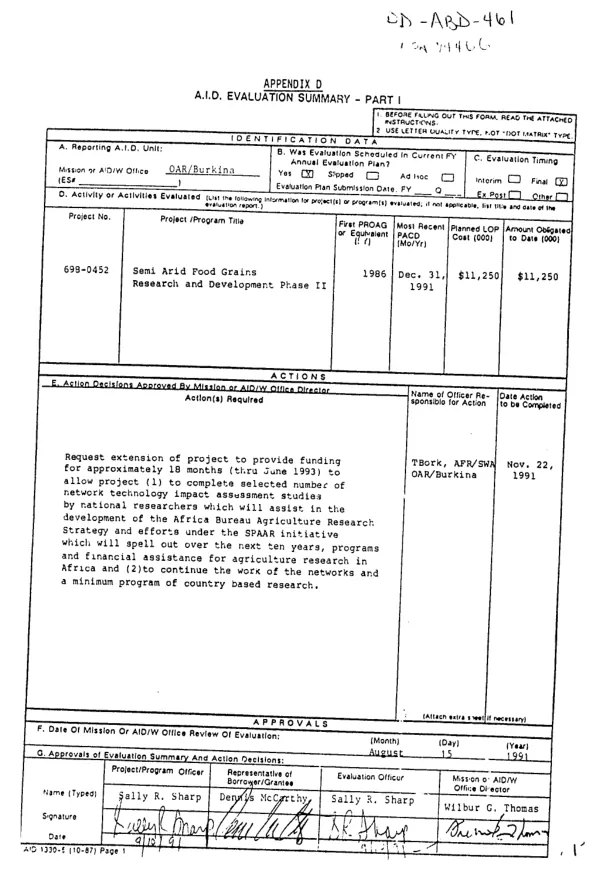
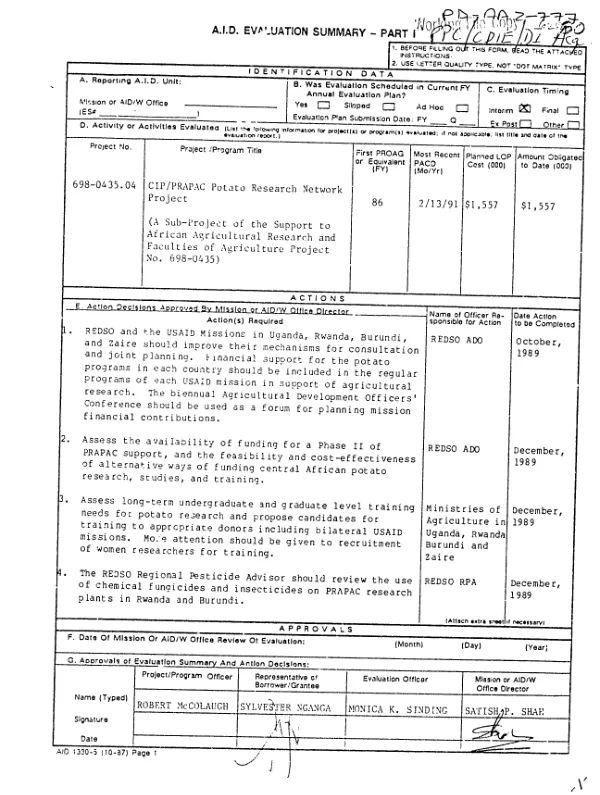
CIP/PRAPAC potato research network project (a sub-project of the support to African agricultural research and faculties of agriculture project no. 698-0435)
Sign inUSAID. BUR. FOR AFRICA. REGIONAL ECONOMIC DEVELOPMENT SERVICES OFC. (REDSO) EAST AFRICA
CIP/PRAPAC potato research network project (a sub-project of the support to African agricultural research and faculties of agriculture project no. 698-0435)
Summarizes mid-term evaluation (XD-AAZ-777-A) of a project to help the International Potato Center (CIP) expand a potato improvement research network (known as PRAPAC) encompassing Rwanda, Burundi, and Zaire.
1970
Sign in to readA free account is required to download.
Abstract
In 1987, Uganda also joined the network. The evaluation covers the period 2/86-5/89. Some progress has been made towards the project purpose, as the small number of potato scientists in the network are being utilized more efficiently. Research progress is evident in such areas as: development and dissemination of improved varieties resistant to major diseases (late blight and bacterial wilt); rapid seed multiplication techniques; production of clean seed; diffused light stores for seed both on-station and on-farm; and dormancy breaking. PRAPAC is also effectively providing short-term training to member countries" scientists. It is difficult, however, to separate the impact of the PRAPAC from the impact of CIP and/or other support for national potato research programs. PRAPAC needs to strengthen interaction between research and extension, which is weak in all member countries, and linkages with agencies responsible for seed multiplication and distribution. PRAPAC also needs to: (1) institutionalize regular socioeconomic data collection and monitoring in order to better focus research on farmers" needs; (2) work with the Rwanda Institute for Agricultural Research (ISAR) to program the use of the grant-funded Ruhengeri training center; (3) improve mechanisms for sharing ideas and technologies; and (4) assemble additional donor support to supplement A.I.D."s resources for work in Zaire and Uganda (this will require initiative from CIP). In another area, the PRAPAC Coordinator"s time has been spent to date on managing construction of the training center and his own residence rather than on providing TA to national potato research programs in the network. Establishment of PRAPAC as an entity distinct from CIP also requires additional attention. Several lessons were learned. (1) Effective networking presupposes the existence of national research programs, development of which requires long-term training and local cost support. (2) Links between research and extension need to be improved for research network investments to have impact. (3) Commodity research networks require special attention to the improvement of seed multiplication and distribution services. (4) Since agricultural research is a long-term process, dramatic results at the farm level cannot be expected within the first few years. During a network"s early years, its coordinator with both scientific and administrative skills who is able to devote full time to promoting collaboration among cooperating countries. (5) The benefits of networking are much more difficult to measure than are the discrete outputs provided by other kinds of development projects.
Related documents
Documents in this collection
 1970
1970USAID DEC
Midterm evaluation of REDSO/ESA"s grant to the International Potato Center (CIP) for the CIP/PRAPAC potato network research project (698-0435.04)
Open record
USAID DEC