USAID DEC
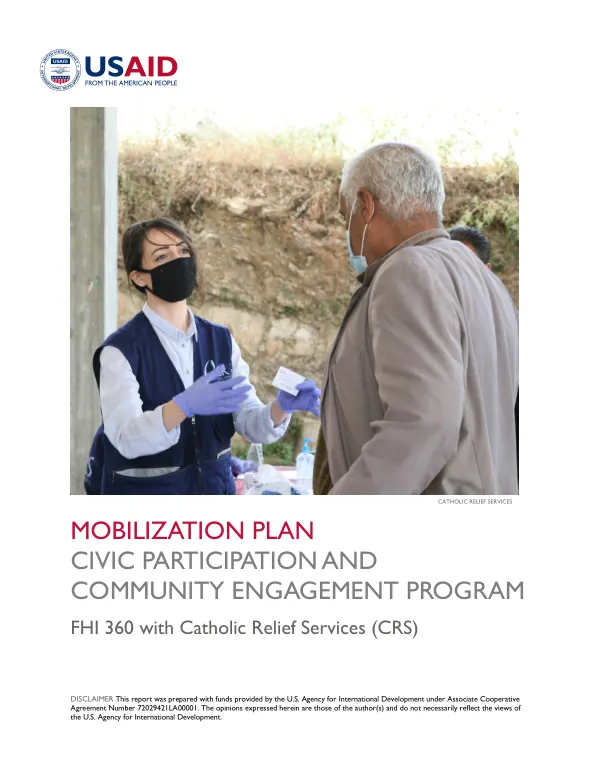
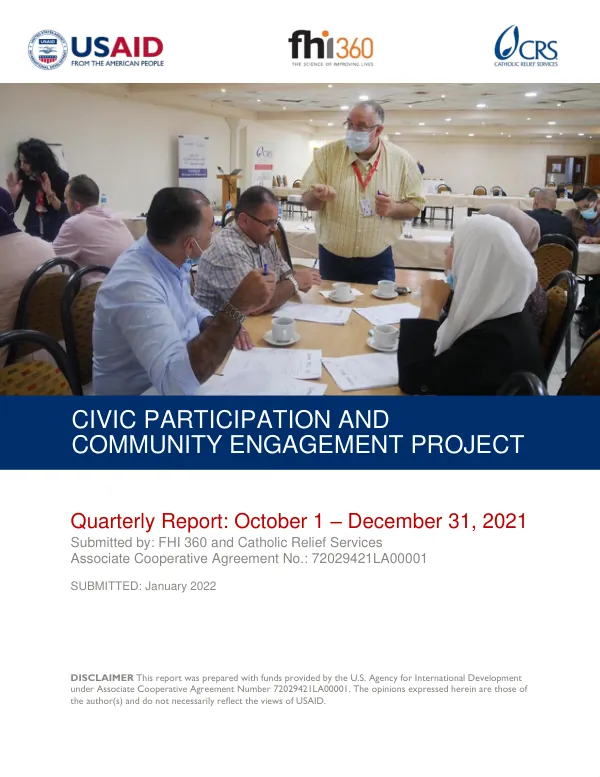
Civic Participation and Community Engagement Project Quarterly Report: October 1 – December 31, 2021
Sign inCATHOLIC RELIEF SERVICES ORGANIZATION
Civic Participation and Community Engagement Project Quarterly Report: October 1 – December 31, 2021
The Civic Participation and Community Engagement Project is a two-year initiative implemented by Catholic Relief Services (CRS) with funding from the United States Agency for International Development (USAID).
2021 · 9 pages
Sign in to readA free account is required to download.
Abstract
The project aims to support civil society organizations (CSOs) in the West Bank and East Jerusalem to enhance their institutional and governance capacities, thus advocating and serving their communities more effectively. The project's two strategic objectives are to improve transparency, accountability, responsiveness, and financial capacity of CSOs, and to increase participatory community development and civic participation. To achieve these objectives, the project will use a tailored approach that is responsive to the unique needs of CSOs with different capacity levels. The project will invest in 10 lower-capacity CSOs, providing holistic, intensive capacity building and institutional strengthening. This will enable these organizations to be more transparent, accountable, responsive, and financially sustainable. The project will also support 25 CSOs with grants and technical assistance to co-create community development and civic-participation plans. During the reporting period, October 1 through December 31, 2021, the project completed several key start-up activities, including a rapid assessment of the civil society landscape in the West Bank and Gaza, development of the Implementation Plan and Activity Monitoring, Evaluation, and Learning Plan (AMELP), and development of key project tools, such as the Grants Manual and the Modified Organizational Capacity Assessment (MOCA). The rapid assessment aimed to build a deeper understanding of the macro-level landscape for CSOs and communities and the micro-level CSO priorities and needs in the immediate-medium-term. The assessment team conducted a combination of primary and secondary data collection and analysis, including key informant interviews with 18 CSOs across the West Bank and East Jerusalem. The findings of the rapid assessment highlighted the need for CSOs to focus on internal governance and strategic planning, including transparency, accountability, and leadership. The assessment also identified opportunities for stronger coalition-building and networking among CSOs and CBOs, and more focus on media and digital technology as means of effective outreach to targeted communities. Based on the findings of the rapid assessment, several recommendations emerged, including the need for funding to be tailored to the core mandates of the CSO, support to CSOs to include a capacity strengthening component, and prioritization of CBOs. The project design should also be participatory, including CSOs and affected populations, to ensure that program components are responsive to community needs and priorities. The Implementation Plan detailed how CPCE will reach 10 CSOs in Year 1 with tailored capacity strengthening support, while selecting 25 CSOs for community development and civic participation grants. The plan also highlighted the need for intentional investment in collaboration, communication, and coordination among CSOs and CBOs, especially through coalitions. The project's progress on implementation during the reporting period was focused on start-up activities, including the completion of the rapid assessment, development of the Implementation Plan and AMELP, and development of key project tools. The project is now positioned for the launch of the Expression of Interest (EOI) for interested CSOs, scheduled for January 2022.