CATHOLIC RELIEF SERVICES ORGANIZATION
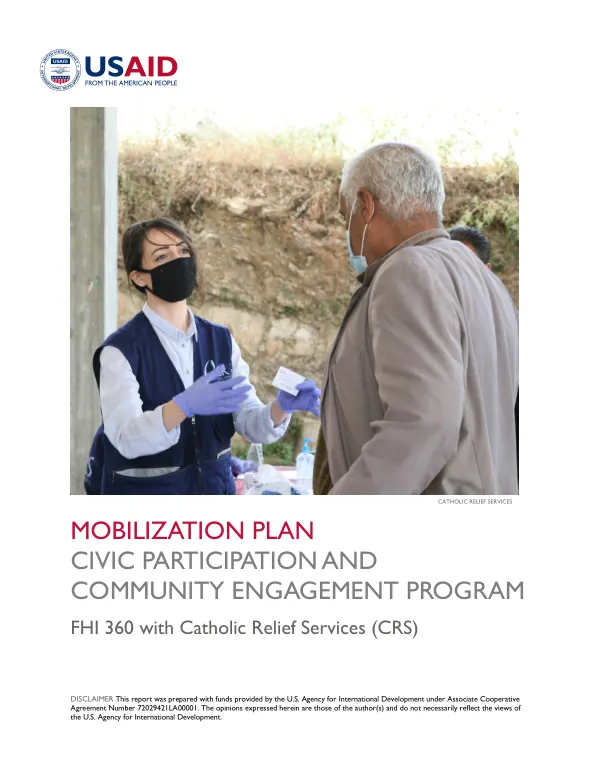
Civic Participation and Community Engagement (CPCE) Project Mobilization Plan
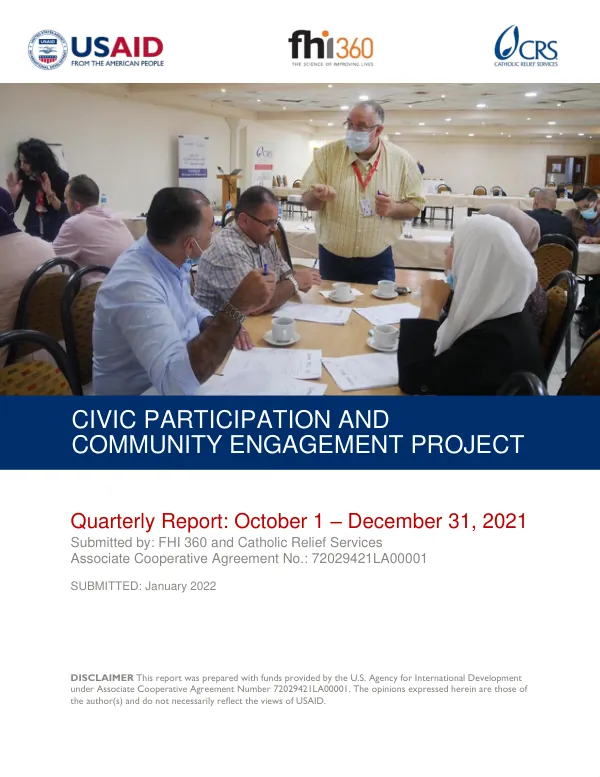
The Civic Participation and Community Engagement (CPCE) Project aims to enhance the institutional and governance capacities of Palestinian civil society organizations (CSOs) in the West Bank.
2021 · 8 pages
Sign in to readA free account is required to download.
Abstract
The project is designed to enable CSOs to effectively advocate and serve citizen demands and interests. The project will utilize a tailored approach that is responsive to the unique needs of CSOs with different capacity levels. The project will support 25 CSOs with grants and technical assistance to co-create development and civic-participation plans with their communities. Priority areas for the project include human rights or rule of law, civic engagement, gender, GBV, disability, and income generation among vulnerable groups. The project aims to reach 25 CSOs, enabling them to reach their organizational development and civic-participation goals in the communities they serve. The CPCE Project will be implemented by Catholic Relief Services (CRS) in partnership with Family Health International (FHI 360) and will be funded by the United States Agency for International Development (USAID). The project will focus on building the capacity of CSOs to deliver services, advance development, and promote civic engagement in the West Bank. The project will have two main components: capacity building and institutional strengthening for 10 lower-capacity CSOs, and grants and technical assistance for selected CSOs to co-create development and civic-participation plans with their communities. The project will also support the development of action plans for capacity building and institutional strengthening activities. The CPCE Project will be implemented over a two-year period, with the first three months focused on operational start-up. During this period, CRS will assemble a team to lead activities in the West Bank, initiate key procurements, and adapt related systems and processes in accordance with project needs. The project will also focus on staffing and recruitment, with an emphasis on selecting, onboarding, and orienting staff who will play central roles in Inception Phase activities. CRS has a strong financial system in place, which will enable the efficient start-up of the project. The system includes clearly defined financial controls at the agency-wide level, supported by an Oracle-based system that consolidates accounting, human resources, supply chain, and budgeting processes into a single platform. This existing system allows CRS to set up the grant award financial monitoring infrastructure immediately, with clear tracking of spending and timely reporting to FHI 360 and USAID. The project will also ensure compliance with USAID Mission Order 21 (MO21) requirements, with a clear internal procedure in place for ensuring full compliance. The CRS JWBG Head of Operations is the focal point for managing policies and procedures and compliance with USAID regulations, and the Chief of Party and Head of Programs will coordinate closely with the Head of Operations and Country Representative on all compliance considerations.