USAID DEC
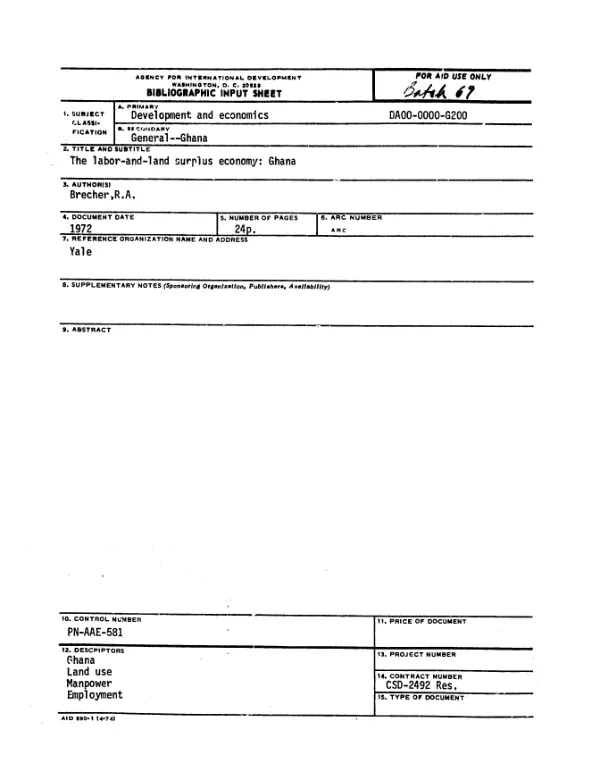
Cocoa, employment, and capital in the Ghanaian economy, a theoretical and empirical analysis
Sign inYALE UNIVERSITY
Cocoa, employment, and capital in the Ghanaian economy, a theoretical and empirical analysis
The paper explores the cocoa industry"s influence on employment of labor and utilization of capital throughout the Ghanaian economy.
Brecher, R. A.; Parker, I. C. · 1970
Sign in to readA free account is required to download.
Abstract
The discussion focuses upon the relationships among the size of the country"s cocoa industry, the distribution of the economy"s labor force between the commercial sectors and the subsistence sector, and the value of the national stock of capital in its relation to national income. These relationships are analyzed theoretically, and some of the important parameters highlighted in this way are estimated empirically for the cocoa sector. A major purpose of this analysis is to reconsider the extent of Ghana"s gain or loss -- in terms of degree of commercialization and magnitude of national income -- arising from an increased level of foreign demand for cocoa. Section2 develops a simple general-equilibrium model, in which heterogeneous capital goods of a sector-specific nature are produced by labor over time, as in Hicks (1973). The investment costs per unit of labor and per unit of capital in cocoa production, as discussed in Section2, are estimated empirically within the context of some simple numerical examples in Section3. These examples are based upon the data given in the Appendix, which generates new estimates of the time structure of yields and labor inputs in cocoa by collating evidence from various sources. The numerical examples are then used to examine the dynamic properties of the model of Section2 when the economy is not in stationary state. Finally, Section4 concludes the paper with some suggestions for future research.