CHEMONICS
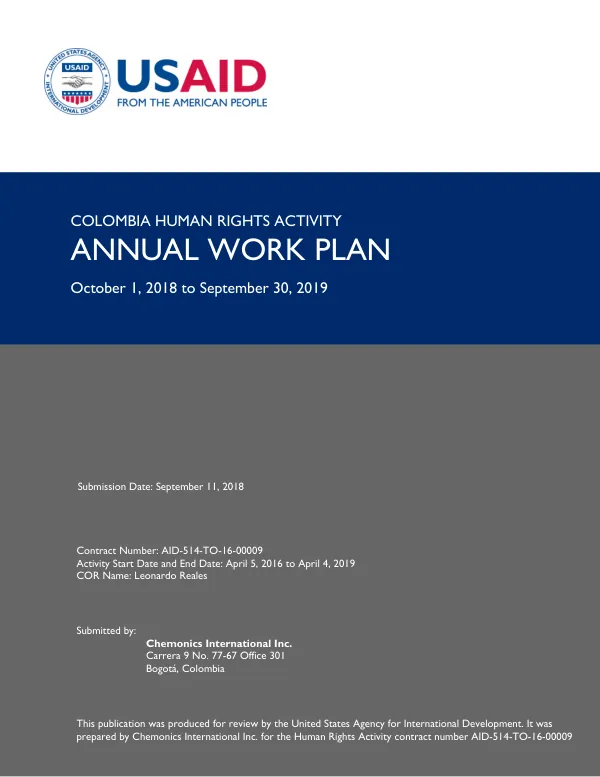
Colombia Human Rights Activity Annual Work Plan
Colombia's post-accord phase has been marked by great challenges and opportunities.
2018 · 59 pages
Sign in to readA free account is required to download.
Abstract
The country has been working to rebuild its communities and institutions after over five decades of internal armed conflict. The Human Rights Activity (HRA), a USAID-funded program, has been an integral strategic partner to the Colombian government in addressing these challenges in 40 of the most conflict-affected municipalities across seven departments. HRA's three principal pillars - Promotion of Human Rights, Prevention of Human Rights Violations, and Response to Human Rights Violations - demonstrate USAID's commitment to Colombians rebuilding their lives and communities. The program has been working to fortify a culture of human rights and peace throughout the country, with a focus on strengthening both institutional and civil society capacities. Colombia's path to peace has proven to be challenging, with a complex web of socially, politically, and economically-driven interests opposed to the peace process. Renewed hot zones of insecurity, instability, and violence have emerged in regions formerly controlled by or in the spheres of influence of the now-demobilized FARC. A boom in illicit crop cultivation and the expansion of illegal economies, including illegal mining, have disproportionately impacted ethnic territories, leading to human rights violations. HRA has adapted its strategies to address the ever-changing post-accord dynamics, prioritizing the crisis of killings and threats against human rights defenders and other social leaders. The program will continue to coordinate its resources and partners to implement targeted strategies to mitigate risks and provide essential tools and skills to vulnerable populations, including youth, journalists, women, and ethnic communities. HRA has been effective in bringing key stakeholders to the table, fostering dialogue, and setting recommendations into motion. The program will continue to forge opportunities, capacities, and spaces to strengthen ties within communities and mobilize stakeholders for the collaborative prevention of human rights violations. Additionally, HRA will empower vulnerable populations through self-protection trainings and the advancement of self-protection networks. As the Activity approaches its mid-point, HRA will concentrate efforts on developing and integrating sustainable solutions and approaches by systematizing successful systems and processes. The program will continue to support groundbreaking initiatives led by civil society organizations (CSOs) working at the local level to address pressing human rights challenges. An emphasis on supporting self-protection capacity building among CSOs will remain a target of this funding support. HRA's grant fund will support initiatives that address a broad range of pressing human rights challenges, with a focus on self-protection capacity building among CSOs. The program will continue to work closely with targeted communities, including youth, journalists, women, and ethnic communities, to provide them with the essential tools and skills to manage risk in areas with limited to no State presence. The role of municipal and departmental human rights committees, Elimination of Violence against Women (EVW) roundtables, and prevention, protection, and guarantee of non-repetition (PPGNR) roundtables will continue to play a crucial role in strengthening and institutionalizing human rights and peace in Colombia's post-accord phase. HRA's efforts will focus on developing and integrating sustainable solutions and approaches to address the complex challenges facing the country.
Related documents