GOVERNMENT OF COLOMBIA
TOWARDS A “COMPLETE PEACE”: ELN NEGOTIATION AGENDA
The peace negotiation agenda between the Government of Colombia (GOC) and the National Liberation Army (ELN) was announced in March 2016, marking a significant step towards a complete peace.
2016 · 2 pages
Sign in to readA free account is required to download.
Abstract
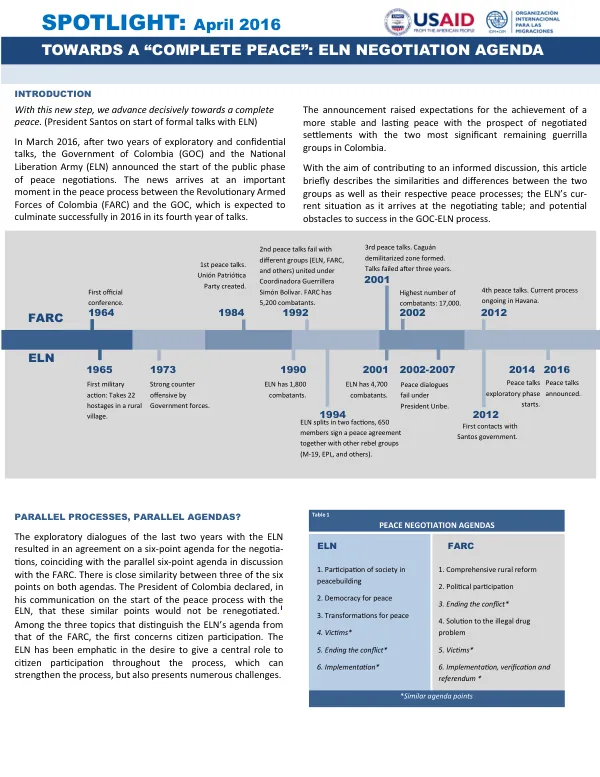
The ELN's agenda consists of six points, with three topics similar to those discussed in the parallel peace talks with the Revolutionary Armed Forces of Colombia (FARC). The ELN's agenda includes citizen participation, democracy for peace, and transformations for peace, which are distinct from the FARC's agenda. The ELN's current situation is complex, as it is recommitting itself to a war against the State while engaging in peace talks. The group has a decentralized structure and a strong presence in local communities, but its image and popular support have been damaged by its involvement in illicit economic activities. The ELN's historic priority has been to build and defend a local political project at the grassroots level, but its actions have been perceived as incoherent by many communities. The peace negotiation process with the ELN is expected to face several challenges, including the horizontal structure and autonomy of the ELN's commanders, the lack of clarity in the agenda, and the participation of civil society. The ELN's decentralized structure and continued attacks may hinder the negotiation process, while the logistics of negotiation in five countries and the lack of clarity in the agenda may lead to an impasse. However, the process has several positive elements, including the headway made on half of the agenda and the hope that progress with the FARC will carry forward the process with the ELN. The ELN and FARC have distinct organizational structures, philosophies, and presences at the local level. The ELN has a more horizontal and federated structure, while the FARC has a more vertical and centralized structure. The ELN's ideology is influenced by liberation theology, messianic concepts, and the Cuban revolution, while the FARC's ideology is rooted in Colombian communism and Marxism-Leninism. The ELN's conception of power is focused on developing policies with communities at the local level, while the FARC's conception of power emphasizes taking power through military force. The ELN's current territorial presence is approximately 8.1% of the country, with an estimated 1,500-2,000 active combatants. In contrast, the FARC has a larger territorial presence, with approximately 21.5% of the country under its control, and an estimated 7,500-8,000 active combatants. The ELN's demands are focused on fighting for the poor, nationalizing the mining and energy sector, and resisting the incursion of foreign capital, while the FARC's demands include agrarian reform and fighting against large landholders.
Related documents