USAID. BUR. FOR AFRICA. OFC. OF REGIONAL AFFAIRS
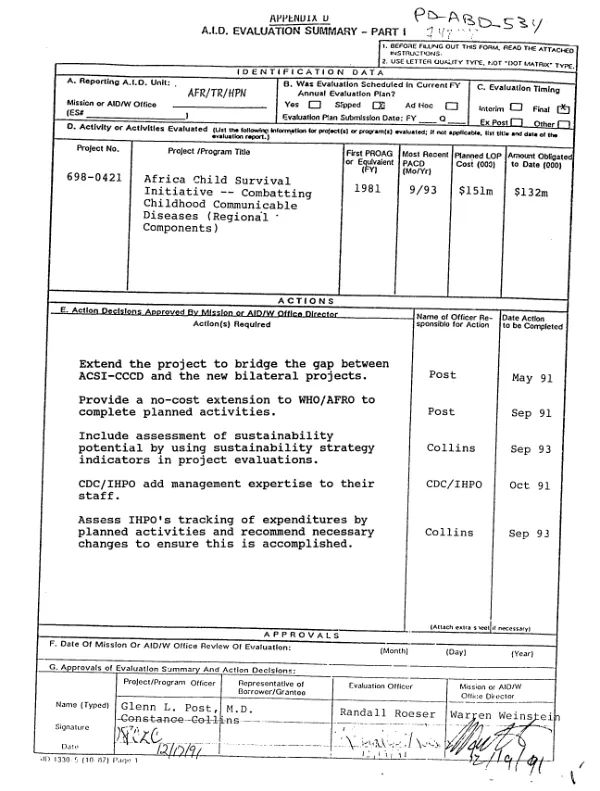
Combatting childhood communicable diseases
Multi-donor project to help the Concerted Action for the Development of Africa combat childhood communicable diseases in sub-Saharan Africa.
1981
Sign in to readA free account is required to download.
Abstract
Project, to be supervised by a joint donor council chaired by A.I.D., consists of a regional effort to assist country personnel involved in Expanded Program of Immunization (EPI) and Control of Diarrheal Disease (CDD) activities and in country-specific efforts. To fill personnel gaps, 42 2-week regional and in-country seminars will be provided for 4,800 senior and mid-level EPI and CDD managers, and over 15,000 staff will be trained at the service delivery level. The World Health Organization will present an expanded version of its training course for cold chain specialists, and 1,000 field-level health workers will attend sub-regional conferences on cold chain equipment and maintenance. Other training will include 10 seminars on communicable childhood diseases (e.g., yaws, yellow fever, malaria) prevalent in a specific country or region. TA and training will be provided to help all levels of the health delivery system develop appropriate data systems. Specifically, surveillance systems will be directed at major causes of morbidity; disease surveillance will be related to persons, place, time, and health care interventions such as immunization and oral rehydration therapy; standardized reporting formats will be encouraged. Management information systems will be developed/strengthened in regard to establishing data needs; data collection, processing, analysis, and use; needs assessment and program development; and program performance and impact. Short-term epidemiological assistance will be provided to generate/revise national EPI and CDD plans. Other activities include contracting a health educator to develop a program to motivate country officials and beneficiaries (especially mothers) to implement/use EPI and CDD services, and supporting studies on operational and management problems and on specific disease interventions. Amendment of 7/30/86 extends project 2 years to 9/30/91 and expands the number of countries assisted from 12 to 14, including Nigeria. Upwardly revised targets are to: (1) immunize 80% of the target population in A.I.D.-assisted countries; (2) provide, within 48 hours of the onset of symptoms, anti-malarials to 60% of cases of acute fevers in infants and children; and (3) treat, within 48 hours of the onset of symptoms, 60% of the cases of diarrhea-induced dehydration presented at clinics and 40% of such cases receiving care at home. The project title is changed to "Africa Child Survival Initiative - Combatting Childhood Communicable Diseases". (PD-JAE-819) Amendment of 10/20/88 provides additional funds so that 10 country subprojects scheduled to terminate in 1988 can continue until the 9/91 PACD. The amendment also authorizes additional Mission buy-ins to centrally funded child survival projects. (PD-ABC-877) Amendment of 4/5/91 extends PACD by 2 years to 9/93 to facilitate a shift to bilateral funding of child survival activities. The amendment will allow countries enough time and money to ensure that child survival activities will continue until new bilateral projects are implemented Country-level PACD"s will vary. Where Missions intend to de-emphasize child survival (Lesotho), the project will be terminated as planned in FY 91. Missions in Swaziland and Togo will begin bilateral projects in FY 92, while Missions in Burundi, Central African Republic, Ivory Coast, Nigeria, and Zaire are not expected to begin such projects before FY 93. (PD-BBZ-438)
![[Development Fund for Africa --] impact of child survival activities in Africa : a report on AID's progress in reducing infant and child mortality and illness in 17 child survival priority countries](https://covers.devme.ai/gen/8905.webp)