USAID. MISSION TO JORDAN
Commodity import program
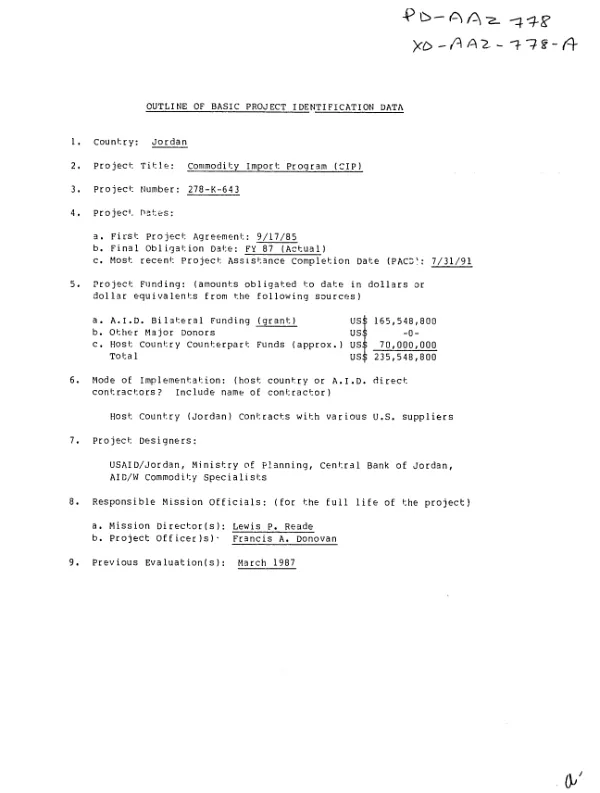
Summarizes final evaluation (XD-AAZ-778-A) of a commodity import program (CIP) in Jordan to provide balance of payments support and promote structural adjustment.
1989
Sign in to readA free account is required to download.
Abstract
The evaluation covered the period FY85-6/89 Despite Jordan"s deteriorating macroeconomic, foreign exchange, and debt positions, the CIP successfully achieved its major objectives. Almost all funds were obligated in a timely, effective manner, and the private sector development projects funded through CIP local currency generations are well planned, covering an impressive array of activities including infrastructure, agriculture, human resources, finance, health, and population planning. These projects could greatly enhance Jordan"s private sector development and provide a foundation for future export promotion activities. On the negative side, USAID/J"s development activities have been inadequately supported by the CIP special account, and privatization efforts to date are disappointing. It is recommended that the next CIP be geared 100% (rather than only 60%) toward the private sector and be focused on export promotion. Policy dialogue under the CIP appears to have laid the groundwork for recent wide-ranging changes including interest rate liberalization and exchange rate reform. The Mission appeared particularly successful in removing a number of restrictive business practices. These reforms should further stimulate private sector activities and employment. The CIP also contributed to technology transfer, employment generation, and increased U.S. exports to Jordan. The program could be strengthened by raising the effective CIP interest rate for private sector borrowers above the current 6.25% rate in order to reduce the program subsidy and maintain its attractiveness to private investors. These subsidies may be justified as start-up costs for attracting private sector banks and enterprises into the program, but they should be diminished substantially in the future. The major lesson learned is the importance of a flexible CIP that can adapt to (1) changing economic and political conditions, as well as to (2) operational inefficiencies.