USAID DEC
Common beans and cowpeas as complementary foods to reduce environmental enteric dysfunction and stunting in Malawian children: study protocol for two randomized controlled trials
Sign inUNIVERSITY OF MARYLAND
Common beans and cowpeas as complementary foods to reduce environmental enteric dysfunction and stunting in Malawian children: study protocol for two randomized controlled trials
Environmental enteric dysfunction (EED) is a chronic subclinical inflammatory condition that develops in children when they are introduced to complementary foods.
2015 · 12 pages
Sign in to readA free account is required to download.
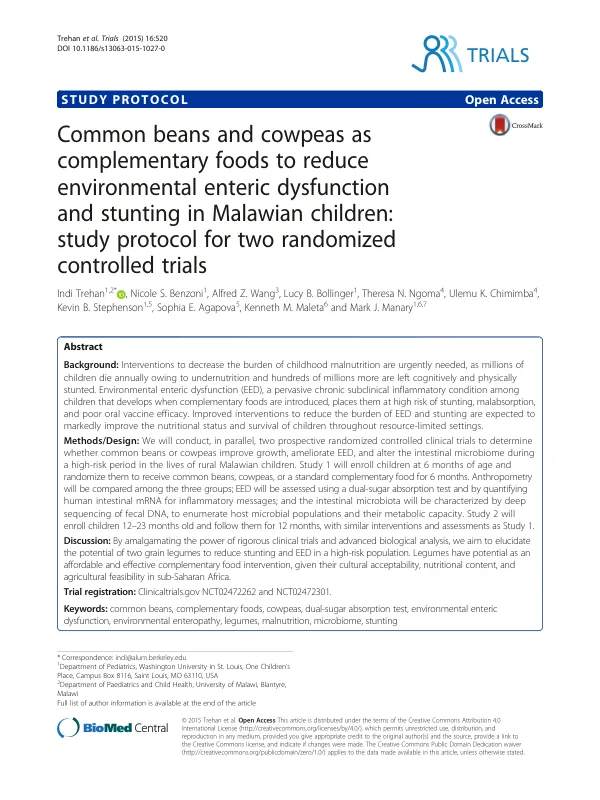
Abstract
This condition is associated with high risk of stunting, malabsorption, and poor oral vaccine efficacy. EED is characterized by T-cell infiltration of the intestinal mucosa, leading to increased intestinal permeability, translocation of gut microbes, micro- and macronutrient malabsorption, and decreased response to enteric vaccines. The development of EED is linked to unsanitary living conditions and is a significant contributor to childhood morbidity and mortality. In traditional sub-Saharan African societies, complementary foods are dominated by monotonous, protein-poor, micronutrient-poor starches, such as maize, cassava, and sorghum. Alternative, yet culturally acceptable, complementary foods that can provide a better balance of nutrients might decrease EED and improve growth. Legumes, including common beans and cowpeas, provide an opportunity to address EED. Legumes have a higher protein content than cereals and are rich in dietary fiber, starch, minerals, vitamins, and antioxidants. Common beans and cowpeas have 3-4-fold more protein per gram than corn, and their zinc content is relatively high, which might further decrease the progression of EED. Legumes make an excellent complementary food for children weaning from exclusive breastfeeding and are quite digestible and well-tolerated when prepared appropriately. Interventions with anti-inflammatory effects might improve gut health, as EED is a chronic inflammatory condition. A growing body of evidence suggests that a diet enriched in legumes decreases markers of inflammation and is correlated with decreases in illnesses with inflammatory components such as colorectal cancer and cardiovascular disease. Evidence from molecular and animal models supports a mechanistic explanation whereby certain legumes may have direct anti-inflammatory effects on the intestines of children with EED. Cowpeas are also attractive for study due to their growth in Africa, cultural acceptance, and hardiness. Cowpeas have significant anti-inflammatory effects, mediated by specific phenolic profiles and antioxidant activity. These phenolic compounds are also active after cooking and simulated enzymatic digestion. The evolving intestinal microbiome in African children warrants study, as a disruption in the relative populations among the four dominant bacterial phyla (Firmicutes, Bacteroidetes, Actinobacteria, and Proteobacteria) is correlated with gut mucosal breakdown in inflammatory bowel disease. A recent study comparing the gut microbiota in children from rural Burkina Faso, who consumed a diet rich in legumes, with European children showed a relative lack of potentially pathogenic Enterobacteriaceae in the African children. Two prospective randomized controlled clinical trials will be conducted to determine whether common beans or cowpeas improve growth, ameliorate EED, and alter the intestinal microbiome during a high-risk period in the lives of rural Malawian children. Study 1 will enroll children at 6 months of age and randomize them to receive common beans, cowpeas, or a standard complementary food for 6 months. Anthropometry will be compared among the three groups; EED will be assessed using a dual-sugar absorption test and by quantifying human intestinal mRNA for inflammatory messages; and the intestinal microbiota will be characterized by deep sequencing of fecal DNA. Study 2 will enroll children 12-23 months old and follow them for 12 months, with similar interventions and assessments as Study 1. By amalgamating the power of rigorous clinical trials and advanced biological analysis, the potential of two grain legumes to reduce stunting and EED in a high-risk population will be elucidated.