USAID DEC
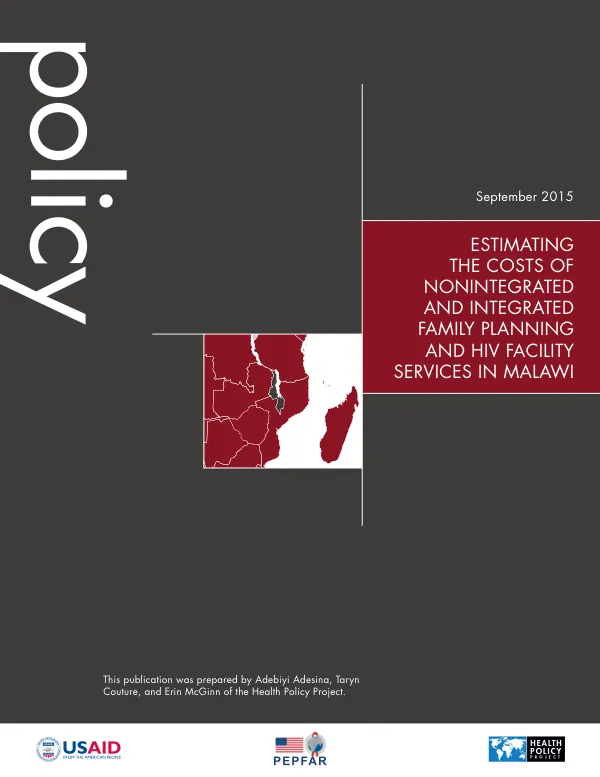
Estimating the Costs of Nonintegrated and Integrated Family Planning and HIV Facility Services in Malawi
Sign inAVENIR HEALTH
Estimating the Costs of Nonintegrated and Integrated Family Planning and HIV Facility Services in Malawi
The Health Policy Project conducted a cost analysis of integrated and nonintegrated family planning (FP) and HIV facility services in Malawi.
2015 · 38 pages
Sign in to readA free account is required to download.
Abstract
The study aimed to estimate the costs of delivering integrated FP services in conjunction with more complex services such as HIV counseling and testing, prevention of mother-to-child transmission, and antiretroviral treatment services. The study objectives were to estimate the cost of delivering integrated FP services, the difference in service delivery cost between health facilities that offer integrated FP services and those that do not, and the specific cost component(s) that drive or carry the largest share of the total cost of service delivery. The study was conducted in 22 health facilities across eight districts in three national regions of Malawi. Data collection consisted of two rounds of document review and interviews at the facilities and district- and regional-level health administrative offices, followed by a second round of validating the quality of the round 1 data and identifying and filling data gaps. The data analysis focused primarily on two areas of the overall cost of service delivery—medical staff and drugs and medical supplies. The results of the study show that the unit cost for the average patient seeking FP services across the 22 facilities is $19.57 per year. For HIV counseling and testing (HCT) service delivery, the average unit cost is $9.10 for all facilities, and the average unit cost of antiretroviral treatment (ART) services is $187 per patient per year for all facilities. When services are delivered as separate services (nonintegrated), the average unit cost for FP services is $24.51 per year, and the average unit cost for HCT services is $12.19 per year. The study also found that the cost of delivering integrated FP and HIV clinical services in Malawi is significantly lower than the cost of delivering FP and HIV clinical services as separate services. The average annual cost of delivering integrated FP and HIV services is $34.67 per patient, compared to $43.70 per patient for nonintegrated services. The study identified the cost of medical staff and commodities, drugs, and supplies in delivering FP and HIV services in the 22 facilities. The study's findings have implications for policymakers and program managers in Malawi and other countries considering or implementing FP/HIV integration. The study highlights the potential benefits of integrating FP and HIV services, including reduced costs and improved efficiency. The study's results can inform policy and program decisions related to FP/HIV integration and resource allocation in Malawi and other countries. The study's methodology involved a cost analysis of integrated and nonintegrated FP services in 22 health facilities across eight districts in three national regions of Malawi. The study collected data on service delivery, facility resources, and financial data, and analyzed the costs of medical staff and drugs and medical supplies. The study's results provide valuable insights into the costs of delivering integrated and nonintegrated FP and HIV services in Malawi. The study's findings have implications for the implementation of FP/HIV integration in Malawi and other countries. The study highlights the need for policymakers and program managers to consider the costs and benefits of integration when making decisions about resource allocation and program implementation. The study's results can inform policy and program decisions related to FP/HIV integration and resource allocation in Malawi and other countries.