DEUTSCHE GESELLSCHAFT FÜR INTERNATIONALE ZUSAMMENARBEIT GMBH
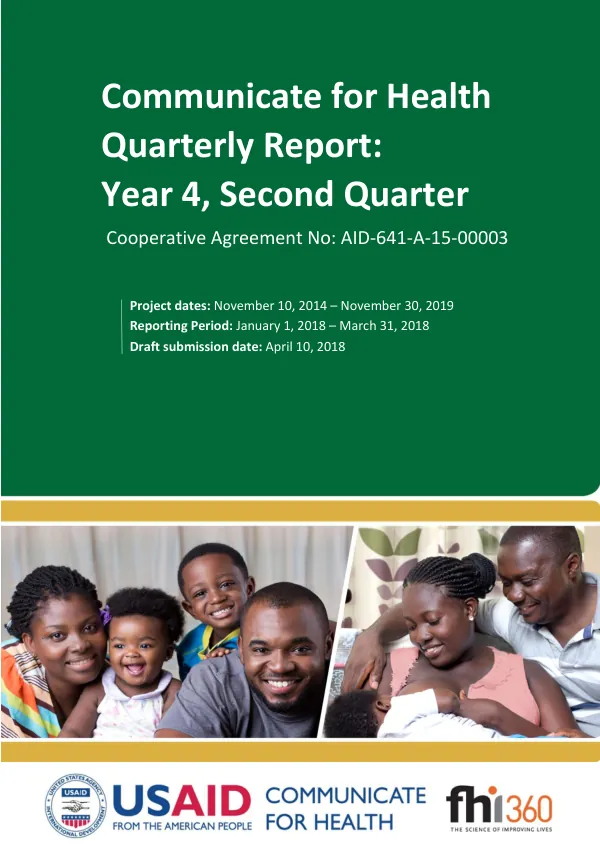
Communicate for Health, Year 4 Quarter 2 Report
The Communicate for Health project was awarded to FHI 360 on November 10, 2014, with a five-year duration.
2018 · 61 pages
Sign in to readA free account is required to download.
Abstract
The project's second quarter of Year 4, spanning from January 1, 2018, to March 31, 2018, saw progress towards all three of Communicate for Health's Expected Results (ERs). IMPROVED BEHAVIORS THAT INCREASE DEMAND FOR KEY INTERVENTIONS (ER 1) was a key focus area during this quarter. The development of new TV and radio spots for a fresh GoodLife campaign, Slice of Life, was underway. The new productions, being developed with the creative firm Mullen Lowe, aimed to build on the refreshed campaign launched in 2016. The GoodLife brand would be reinforced as a companion featuring various Life Stage audiences with messages that are action-oriented and emotion-grabbing, interwoven with local proverbs and traditional sayings that would reinforce the campaign's catch phrase, It's an #everydaything. The new productions would be complemented by personal endorsements for the campaign and GoodLife messages by the First Lady of Ghana. The Ghana Health Service and Communicate for Health were enthusiastic about the new campaign and its potential to resonate with the Ghanaian people. Slice of Life was expected to be launched in Q3. Strong regional radio coverage was at the heart of Communicate for Health's broadcast strategy during this quarter. A total of 1,075 GoodLife radio spots on a range of health themes, including family planning, water, sanitation, and hygiene, malaria case management, use of long-lasting insecticide-treated nets, breastfeeding, Vitamin A, and newborn care, were aired during peak and prime time on eleven top-rated regional radio stations. Broadcasts were in six local languages, including Twi, Fanti, Dagbani, Ewe, Gonja, and Likpakpa, as well as English, to maximize listener engagement and interest. Pretesting of the 4-minute humorous TV and radio spot on family planning featuring a taxi driver, his pregnant wife, and friends was also completed during this quarter. Four local language versions of the spot were pretested. Local languages included Gurune for Upper East, Dagbani for Northern, and Dagaare for Upper West, while Hausa cuts across all northern regions. Pretest findings suggested that messages for the north needed to use the term birth spacing rather than family planning, which audiences interpreted as limiting family size, to which many respondents had strong reservations. Good progress was made on preparing for the transition of the GoodLife social media platform to the GHS as part of the overall Communicate for Health transition and sustainability strategy. A plan for the transition was developed and endorsed by the GHS Family Health Division/Health Promotion Department (FHD/HPD) during the quarter. Beginning in Q3, three HPD staff and one FHD staff would commence a three-week intensive program with Creative Storm Networks, marking the official beginning of the transition and migration of the platform to the GHS. Collaborative work and coordination with USAID Implementing Partners (IPs) and other groups was again strong during this quarter. A total of 4,250 GoodLife-branded posters and 35 pull-up banners on different health topics were produced for Systems for Health to support community-level interpersonal communication (IPC) and general Community-Based Health Planning and Services (CHPS) outreach work in the Northern and Volta regions. Radio spots on WASH themes produced with WASH for Health were broadcast in the five USAID priority regions, while new print materials on patient rights developed by People for Health were reviewed and recommendations made. Partner participation in the Northern Region SBCC USAID IPs Coordination Committee saw a major boost with the addition of more than 18 new organizations. The Health Sector SBCC Technical Review Committee continued to gain popularity, recognition, and support, with new donor agencies such as the Japan International Cooperation Agency (JICA), the Deutsche Gesellschaft Internationale Zusammennarbeit (GIZ), and People for Health using the process to solicit feedback and obtain official GHS approval for new campaigns and materials. Due to popular demand, beginning in late December, TV3 rebroadcast all four seasons (52 episodes) of the hit TV show for youth, YOLO, You Only Live Once. The rebroadcasts were aired at no cost to the project. Adding depth to the educational slant of the series, a new 13-episode talk show series, The YOLO Hangout, was introduced. The Oprah-style production featured TV personalities discussing various health and social issues affecting youth in Ghana. The Communicate for Health project continued to engage with various stakeholders, including the Ghana Health Service, USAID Implementing Partners, and other groups, to promote social and behavior change communication and media. The project's efforts aimed to increase demand for key interventions, improve behaviors, and ultimately contribute to the reduction of maternal and child mortality in Ghana.
Related documents