UNIVERSITY OF WISCONSIN AT MADISON
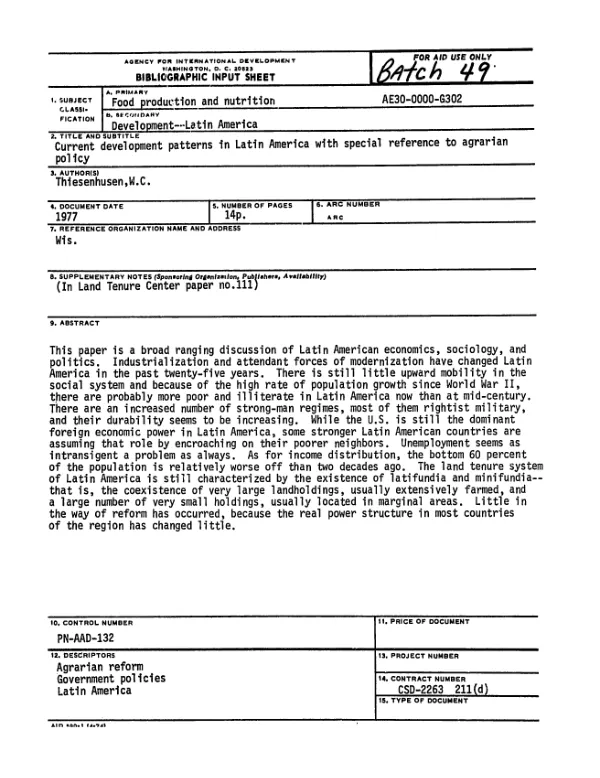
Communication and institutional change in Mexican agricultural development
Two contrasting approaches have guided the planning of most rural development projects in Latin America.
Diaz, Heliodoro; Felstehausen, Herman · 1970
Sign in to readA free account is required to download.
Abstract
One approach has been to identify key economic variables or factors and mount a focused attack to correct specific shortcomings in present production systems or to make injections of missing inputs so existing enterprises could be expanded. This approach focuses development planning primarily on questions of economic organization and the allocation of physical and technical inputs. The second approach is to view development basically as a complex set of interrelated rules or norms which control the behavior of individuals who distribute resources, allocate benefits and regulate the use of inputs and services. The Puebla Project in Mexico constitutes an instructive demonstration on the complexity of factors which must be confronted in order to make some lasting change in rural conditions in Latin America. Furthermore, the project is an example of a scheme where institutional change constitutes the major criterion of project success. Institutional and communication processes are described and defined in this presentation in an attempt to remove some of the confusion about the meaning and significance of this approach. Following the explanation of concepts, an attempt is made to illustrate the concepts with examples from the Puebla Project experience in Mexico.