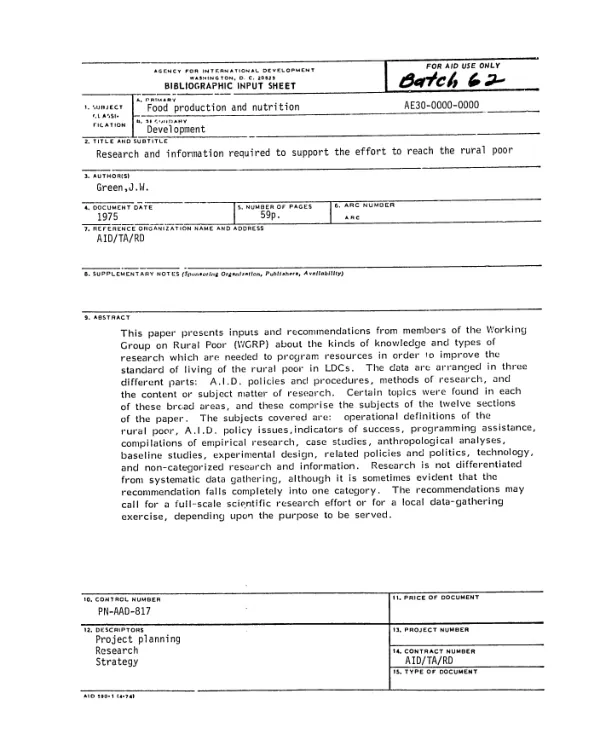
USAID. BUR. FOR TECHNICAL ASSISTANCE. OFC. OF RURAL DEVELOPMENT
WOMEN AND PARTICIPATION
This paper discusses women"s participation in LDC"s with a broad and divergent set of countries represented; the documentation focuses on Africa.
STAUDT, KATHLEEN A. · 1970
Sign in to readA free account is required to download.
Abstract
It is addressed to the concerns of two reader audiences; researchers and programmers. In the last decade, studies have shown that economic growth in itself does not ensure equitable distribution of benefits. A recognition of how economic stratification acts to filter and skew services has led analysts to further differentiate and disaggregrate rural residents according to land size, income, and crops. Similarly, sexual stratification has affected the allocation of services within households. Further understanding of the complexities of rural development cannot be reached without an awareness of how class and sex interact to stratify benefits. The linkage between economic participation and political participation needs to be fully explored. Economic participation alone will not build workable relationships, or establish accountability, between women as a clientele and administrative agencies. A prior or complementary condition -- organizational participation -- can initiate, facilitate and sustain those clientele relationships. Initially this can be accomplished through separate women"s organizations, establishing multiple linkages with programs and agencies. Various aspects of such women"s organizations are discussed, including incentives, representativeness and organizational autonomy. A model is introduced for assessing programs and staff, focusing on the dichotomization of work roles between the sexes. In certain societies an integrated organizational strategy may be more appropriate than separate groups. Such a strategy requires a thorough consideration of the benefits and harmful consequences of programs for women"s access to productive resources.