USAID DEC
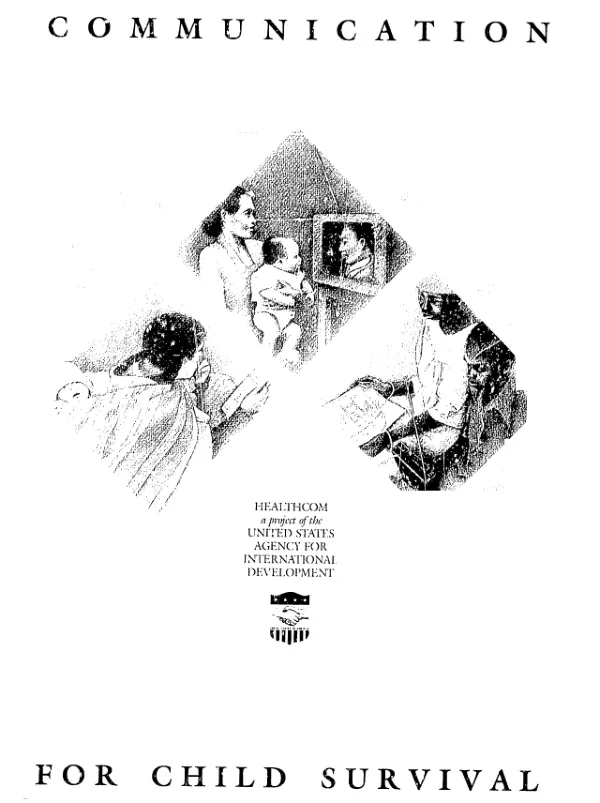
[Communication for child survival : HealthCom project final report --] executive summary
Sign inACADEMY FOR EDUCATIONAL DEVELOPMENT, INC. (AED)
[Communication for child survival : HealthCom project final report --] executive summary
Final report by the contractor (Academy for Educational Development) on a project to develop health communication methodologies for child survival.
1991
Sign in to readA free account is required to download.
![[Communication for child survival : HealthCom project final report --] executive summary](https://covers.devme.ai/gen/33533.webp)
Abstract
Report covers the period 9/85-3/91. Through HealthCom"s extensive experience at 14 long-term and 11 short-term sites throughout Asia/Near East, Africa, Latin America, and the Caribbean, a number of important lessons were learned. Issues of collaboration, monitoring and evaluation, training and curriculum development, integration, and community participation emerged as important challenges for the future. Other communication-specific lessons are summarized below. Each technology has its own communication needs (e.g., ORT requires skills training as well as attitude change; EPI focuses on time-point compliance; nutrition often requires small but durable changes in routine behavior; and water and sanitation require a community rather than just individual changes). Education by itself is not enough to induce or sustain most behavior change. The "KAP-Gap" -- the discrepancy between those who have correct knowledge and those who demonstrate positive practices -- is perhaps the major challenge of a communication program. Consumers may be prevented from adopting a new behavior by the "price" or "place" of the product or by obstacles in the culture or the service delivery system. Planners must investigate what motivates first trial and sustained behavior. Audience research is indispensable to selecting strategies, testing materials, and monitoring effectiveness. The consumer"s needs, perceptions, and the realities of his or her environment (economic, social, and cultural) should guide every aspect of the communication program. Communication channels must be integrated to maximize their particular strengths. Although broadcast media may have the greatest frequency and reach among a particular audience groups, only print materials can provide detailed information and can be kept in the home to be used when needed and only face-to-face interaction can provide personal reinforcement, which is not easily achieved by other channels. Short-lived campaigns are ultimately ineffective and can be harmful. Although pilot interventions can be useful to test strategies or to give high visibility to a health technology, the regular service delivery system is the long-term source of health services and must be strengthened; it can be easily undermined by one-time efforts which divert resources and energy. Community participation helps sustain short-term media gains. The involvement of local groups in health promotion is indispensable in sustaining behavior change over the long-term. The influence of community leaders and family members on the adoption of new behaviors should be presumed and carefully targeted. Supply and demand must be balanced and provided together. Although a health communication project necessarily focuses on the creation of consumer demand, planners must coordinate with the supply structure to assure demands are not frustrated and programs undermined. Behavior change requires continuity of resources and support. Changes in health practices take place over the long-term, and new consumers are constantly entering the "market." Measurement of cost-effectiveness is difficult but essential as part of the institutionalization process. Policy makers must be convinced of the efficacy of programs in terms of resources expended and results achieved. Institutionalization is its own master, requiring specific strategies planned and initiated early. Communication programs are by nature cooperative efforts involving many partners who should be knowledgeable and committed to the approach as early in the process as possible. They will learn through experience and through collaboration and be reinforced through a sense of ownership in a program"s achievements. (Author abstract)
Related documents