ACADEMY FOR EDUCATIONAL DEVELOPMENT, INC. (AED)
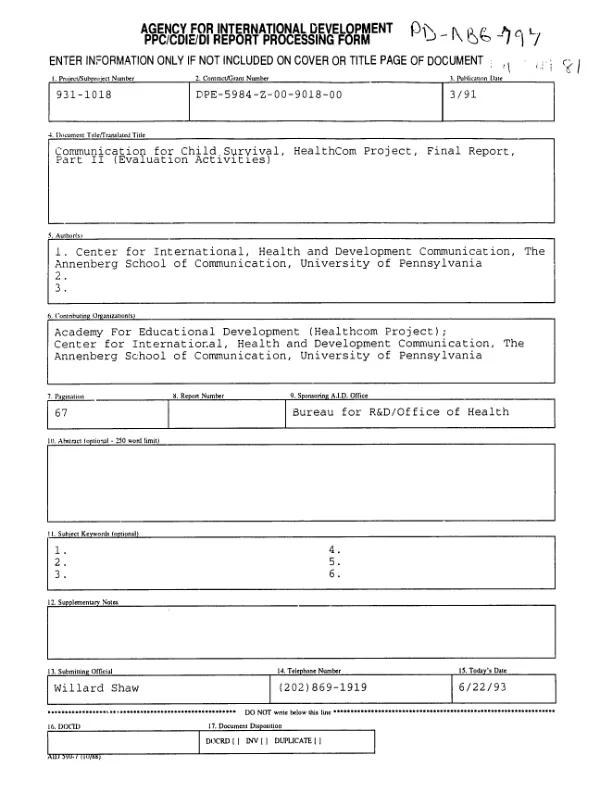
Communication for child survival : healthcom project
Final report by the contractor, the Academy for Educational Development, on the Healthcom project (9/85-3/91) to develop a methodology for using modern communication, social marketing, and behavior analysis techniques to improve child care practices.
1991
Sign in to readA free account is required to download.
Abstract
The project developed a multidisciplinary communications methodology incorporating three key elements -- social marketing, behavior analysis, and anthropology -- and based on a genuine respect for the needs of the consumer. For example, social marketing techniques were used in the Philippines, where measles vaccinations were promoted via radio and TV ads and activities for clinic workers. Behavior analysis was used in developing strategies for community education programs, including The Gambia"s Happy Baby Lottery, Ecuador"s Gold Star Immunization Campaign, and Indonesia"s health volunteer training program. The project utilized anthropological ethnographic research in Zaire where project anthropologists found that village women perceived dehydration (lukunga) as a disease distinct from diarrhea and treated it by rubbing oil and ashes on the fontanelle. This information was used to develop messages linking lukunga to diarrhea and promoting oral rehydration therapy for its treatment. Long-term TA -- provided in 14 countries -- focused on institution building covering a range of communication strategies (e.g., radio, print, health worker training) conducted in cooperation with diverse groups in the public, voluntary, commercial, and international sectors. The project also provided short-term TA in 11 countries; carried out 12 studies of health practices and numerous impact assessments; published special reports, field notes, and journal articles, etc; created training videos; and conducted workshops and training programs. Positive health outcomes from project activities can be seen in the following statistical increases: measles immunization in Metro Manila region in the Philippines, from 21% to 45%; use of Vitamin A capsules among consumers near a health post in Central Java, from 24% to 40%; home use of ORT in Ecuador, from 38% to 53%; feeding of special diets following diarrhea, in Swaziland, from 16% to 44%; use of chloroquine by pregnant women in Malawi, from 25% to 91%. Several very important lessons were learned. (1) Each technology (e.g., ORT, immunization, nutrition) requires a particular communications strategy. (2) Education alone is usually not enough to induce or sustain behavioral change. (3) Audience research is indispensable. (3) Communications media (broadcast, print, interpersonal) must be integrated. (4) Short-lived campaigns are ultimately ineffective and can be harmful (because they divert resources from regular health services). (5) Community participation can help sustain short-term media gains. (6) Supply and demand must be balanced and provided together. (7) Behavior change requires continuity of resources and support. (8) Measurement of cost-effectiveness is difficult but essential as part of the institutionalization process. (9) Institutionalization requires specific strategies, planned and initiated early on. (Author abstract, modified)
Related documents
![[Communication for child survival : HealthCom project final report --] executive summary](https://covers.devme.ai/gen/33533.webp)