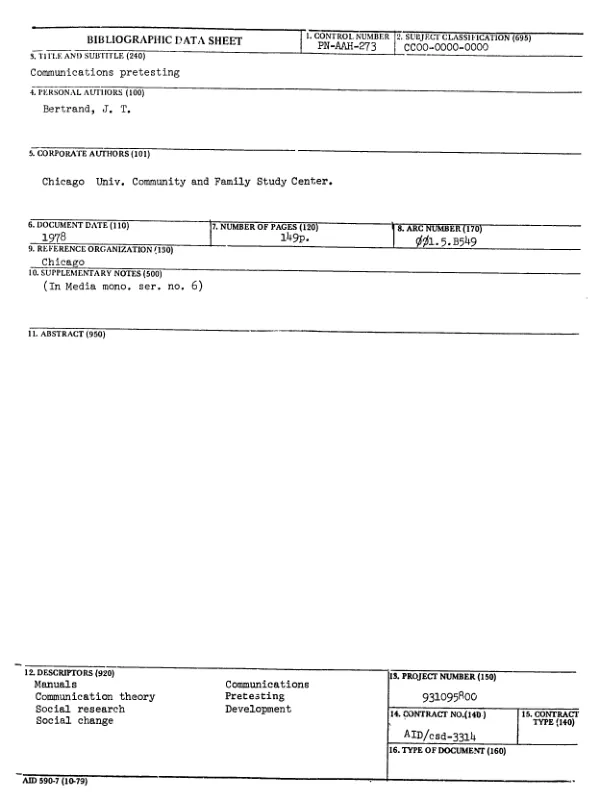
UNIVERSITY OF CHICAGO. COMMUNITY AND FAMILY STUDY CENTER
COMMUNICATIONS PRETESTING
The majority of social development programs around the world stand to benefit from communicating their activities through the mass media.
BERTRAND, JANE T. · 1970
Sign in to readA free account is required to download.
Abstract
Most program administrators will invest in communications that will effectively reach a target population but will avoid squandering limited resources on costly productions that create negative results in the field. Through pretesting, the reaction of a group of individuals to a communication can be measured, resulting in the possibility of diffusing the most acceptable, most appropriate communication possible. In a "how-to" format, this monograph presents suggestions for pretest designs for radio and television spot announcements, posters, pamphlets, and movies, as well as techniques in initially designing, conducting, and analyzing the results of the pretest. For any type of media, pretests are designed to identify those messages which are potentially most effective, namely, which are: most attractive and gain the most attention; most easily understood; most acceptable and least likely to create a negative reaction; best at creating the feeling of self-involvement with the topic; and most persuasive. The pretests presented in this pamphlet all adhere to the following criteria: they are economical; they require no special pretesting equipment or test facilities; they can be carried out by people with limited research training; most are appropriate to use in developing countries with nonliterate populations; and they yield results that can be hand tabulated for rapid feedback to the communications staff. Personnel who should be involved involved in this activity include the director of the organization (to ensure that the pretest is being implemented in ways which will improve the communications program) and members of the research division (to objectively evaluate the pretest results). When a separate research division is not available, the communication staff itself may evaluate the pretest; however, the persons who designed the pretest should neither conduct the pretest nor tabulate the results. At the conclusion of the monograph, the author provides four sources (1968, 1973, 1975) for further reference.