USAID DEC
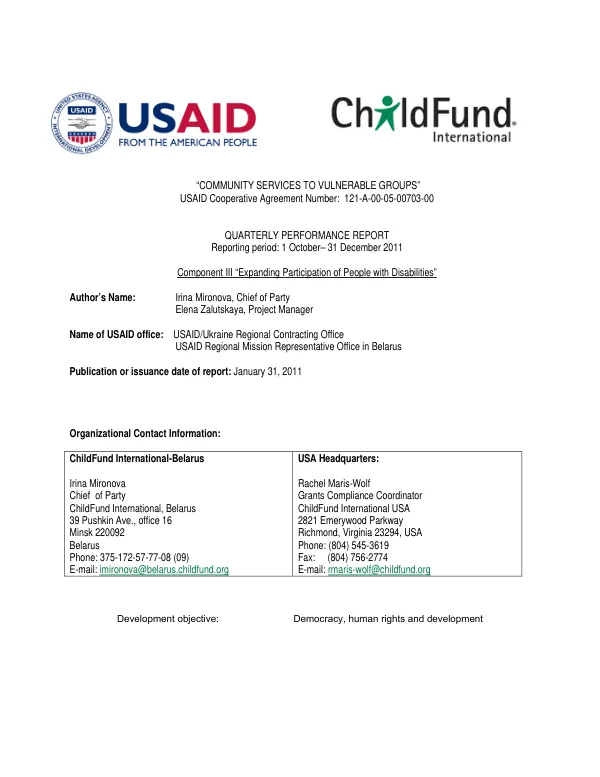
Community Services to Vulnerable Groups: Expanding Participation of People with Disabilities Quarterly report October-December 2011
Sign inYOUNG WOMEN’S CHRISTIAN ASSOCIATION OF RWANDA
Community Services to Vulnerable Groups: Expanding Participation of People with Disabilities Quarterly report October-December 2011
The project "Community Services to Vulnerable Groups: Expanding Participation of People with Disabilities" was implemented in Belarus from 2011 to 2012.
2011 · 17 pages
Sign in to readA free account is required to download.
Abstract
The project aimed to include Belarusian people with disabilities into mainstream society and strengthen the capacity of organizations of persons with disabilities. The project was implemented by ChildFund International-Belarus, with funding from the United States Agency for International Development (USAID). The project had three main objectives: to support initiatives of people with disabilities and extend the range of services provided by local organizations to PWD in urban and rural areas through small grants; to support advocacy efforts by PWD grassroots organizations to promote rights of people with disabilities and increase public awareness about people with disabilities; and to improve the capacity of grassroots organizations that support PWD and their families. During the reporting period of October-December 2011, the project implemented three small grants, awarded in Year 3, for a total amount of USD 14,977. These grants resulted in the creation of 13 new services for people with disabilities, including HIV/AIDS prevention among youth with disabilities, social rehabilitation of people with spinal injury, and inclusion of children in wheelchairs into community life. The new services provided through small grants were appreciated by the project's clients. The project also conducted two capacity-building events for people with disabilities, trained 150 PWD-related specialists, and initiated and implemented 13 advocacy efforts by participating PWDs or partner DPOs. Alumni of training courses conducted by ChildFund Belarus in previous years took leadership positions in the different types of training and advocacy activities. The project faced challenges due to the devaluation of the national currency, which resulted in significant losses for ChildFund's partner DPOs. However, the partner DPOs adjusted their budgets and were looking for additional resources to implement all the planned activities and meet the targets. The project's monitoring and evaluation data showed that 13 services for PWD were created, 67 adults with disabilities and 61 children with disabilities obtained access to new or improved services, and 111 family members participated in small project activities. The project's technical assistance team provided feedback on improving small grant performance and administrative procedures. The project's success was demonstrated by the strong stimulus provided by the training courses to the activities of PWD grassroots organizations. The project's alumni took leadership positions in the different types of training and advocacy activities, and some of them developed projects that were submitted to ChildFund's small grant competition. The project's concept of network development between partner DPOs that received technical assistance from the project in Years 1-3 was also developed. The concept paper will be discussed next quarter within a Roundtable with alumni of ChildFund training programs and small grant implementers. The project's achievements were recognized by the Ministry of Health, which decided to create a Task Force on quality improvement of rehabilitation programs for people with disabilities. The project's success was also demonstrated by the creation of 13 new services for people with disabilities, the training of 150 PWD-related specialists, and the initiation and implementation of 13 advocacy efforts by participating PWDs or partner DPOs.