USAID DEC
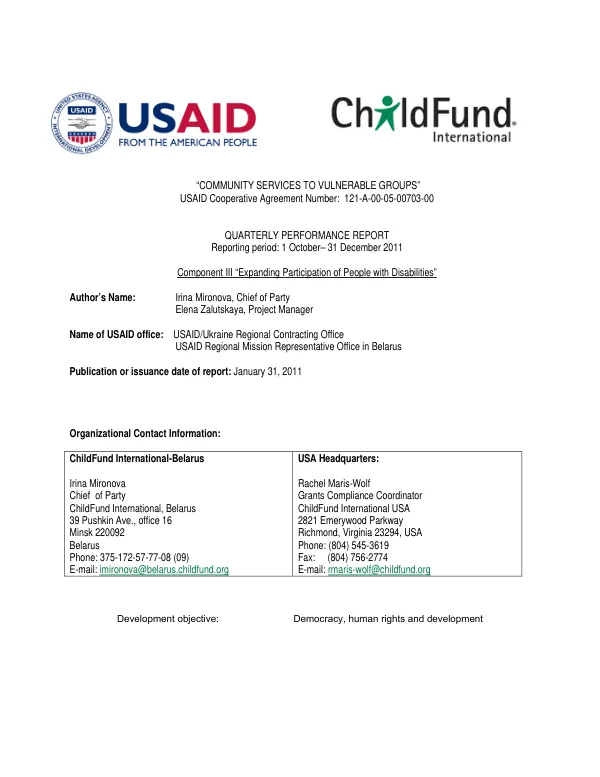
Community Services to Vulnerable Groups: Quarterly Program Report October – December 2011
Sign inCHILD FUND INTERNATIONAL
Community Services to Vulnerable Groups: Quarterly Program Report October – December 2011
The Community Services to Vulnerable Groups project in Belarus aims to reduce the number of children in institutionalized care and promote family-based care.
2011 · 22 pages
Sign in to readA free account is required to download.
Abstract
The project targets "social orphans," children whose parents are living but unable to provide proper care, or children of parents who have been denied parental rights. The project's activities focus on working with families and social service professionals to maintain and reintegrate children within their original family units. The project has three main objectives: improving access to and development of an integrated system of community-based prevention and rehabilitation services for families and at-risk children; improving the quality of training and education available to social service providers and building awareness of community members surrounding the development of favorable family environments for children; and promoting de-institutionalization of children through technical assistance to national child welfare agencies in strengthening the national regulatory and methodological base. This quarter, the project was implemented according to its work plan and budget, with preparations to and implementation of the award ceiling increase received in September 2011. Activities included selection, recruitment, and orientation of additional program and technical staff, development of the Annual Implementation Plan, and revision of the existing Performance Measurement Plan. ChildFund Belarus continued its efforts promoting sustainability of previously introduced programmatic elements, including reformation of the child protection system, development of family-type placement for orphaned children, and improvement of parenting skills and competencies to prevent child abuse and neglect. One of the main project highlights was a National Conference on Quality Standards in Child Protection, organized in partnership with the Ministry of Education, UNICEF, the Academy of Post-Diploma Education, and the INGO "Hope and Homes for Children." The conference brought together 150 participants, including representatives of government agencies, child protection authorities, and practitioners from all over the country. OVC partners from the targeted communities presented the positive impact of quality standards pioneered by their respective communities during the course of project implementation. ChildFund Belarus also undertook efforts to mobilize the NGO community for more active participation in the de-institutionalization process and child protection. Eighteen participants representing 16 NGOs from all over Belarus participated in training on Child Abuse and Neglect, where they learned about the risk factors and the multi-faceted consequences of child abuse and neglect. The participants identified the NGO role in child abuse and neglect prevention and came up with their ideas for innovative projects. About 50% of them submitted their proposals to the small grant competitions announced this quarter. The project also pioneered an adoption training course with U.S. experts, which was the first ever in Belarus training on adoption that introduced local specialists to the best international practices and modern approaches to adoption development. The participants highly appreciated the knowledge and skills obtained at the first two training sessions. Geographic expansion and implementation of three selected project components were based on extensive training for service providers and small grants. ChildFund Belarus continued its partnership with the network of Committees on Juvenile Delinquency and conducted a 3-day workshop on the Family-centered Approach to Child Protection for the heads of 7 district committees on Juvenile Delinquency and police departments of Minsk. At the request of the Ministry of Education, ChildFund Belarus submitted 33 proposals to be included in the National Action Plan to Improve Children's Lives and Protect Children's Rights for 2012-2015. These proposals aimed to improve the functioning of the child protection system, early detection, introduction of quality standards into national legislation, improvement of re-training for child protection specialists, and inclusive education. Two Calls for proposals were announced to support the development of multidisciplinary cooperation in child protection services, a life skills training program for children and teenagers, family-type care, dissemination and sustainability of the Parenting Skills Enhancement Program in local communities, inclusion of children with disabilities and their families, and services for children with disabilities. The project has achieved several milestones, including the operation of 5 projects on child protection reforms for a total amount of $12,920 USD, serving 1,048 parents and 124 children, and training 240 child protection specialists and 39 representatives of NGOs on service provision to vulnerable children and families. Additionally, 465 child protection specialists from local communities were trained on a Family-Centered Approach by TOT alumni.
Related documents