USAID. MISSION TO HAITI
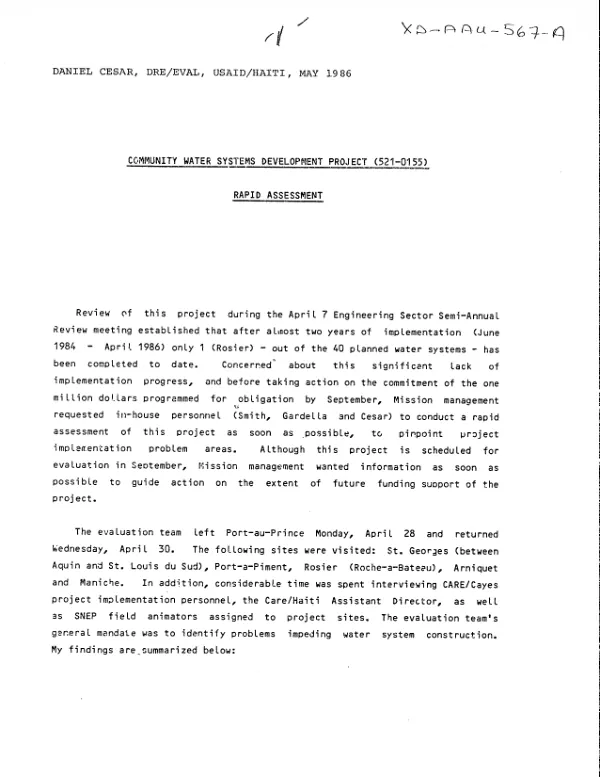
Community water systems development project (521-0155) : rapid assessment
Evaluates project implemented by CARE to build and maintain community potable water systems in Haiti.
Cesar, Daniel · 1986
Sign in to readA free account is required to download.
Abstract
USAID/E team rapid assessment covers the period 6/84-4/86 and is based on site visits and interviews with personnel from USAID/H, CARE, and the National Potable Water Service (SNEP). Construction activities fell behind schedule from start-up and have continued in that vein. Only the system at Rosier is completed. Construction is 3 months behind at Port-a-Piment and 2 months behind at St. Georges, Arniquet, and Maniche. Work will begin on 4 other systems between 4/86 and 8/86. A number of factors are responsible. Initial problems included unrealistic project design expectations, staffing problems at CARE, the late disbursement of the second - and major - tranche of project funds, and a poor working between SNEP and CARE. During the project"s second year, implementation was further impeded by heavy rains, fuel shortages, and, most seriously, growing civil unrest culminating in the overthrow of the Duvalier regime. Due to the civil disturbances, field travel was restricted and the project office had to close from time to time. There have also been difficulties in promoting strong community participation. Most of the participating villagers are either the poor who are providing wage labor or the town "notables" and project animators who motivate, plan, and organize system construction. Voluntary labor is provided rather readily in places where the work phase is short or where there is a history of community self-help, but where the opposite is true, as in Port-a-Piment, voluntary work has been especially problematic. Problems have also stemmed from differing perceptions of Food for Work (FFW) rations, which are used to compensate residents who have already donated voluntary labor. CARE believes the rations enourage people who are working to develop their community, whereas villagers see them as a wage which, at one-third the minimum daily rate, is insufficient. Further complicating the community participation issue have been the protests and demonstrations attendant upon Duvalier"s overthrow. CARE will have to spend considerable time to regain the confidence of community members and may have to change its ration policy. CARE has already taken several positive steps to improve program productivity. Food distribution (although not the ration size) has been made more equitable, schedules have been adjusted to allow workers more time with their families, and CARE staff is now working simultaneously at six project sites in order to increase coverage.