USAID DEC
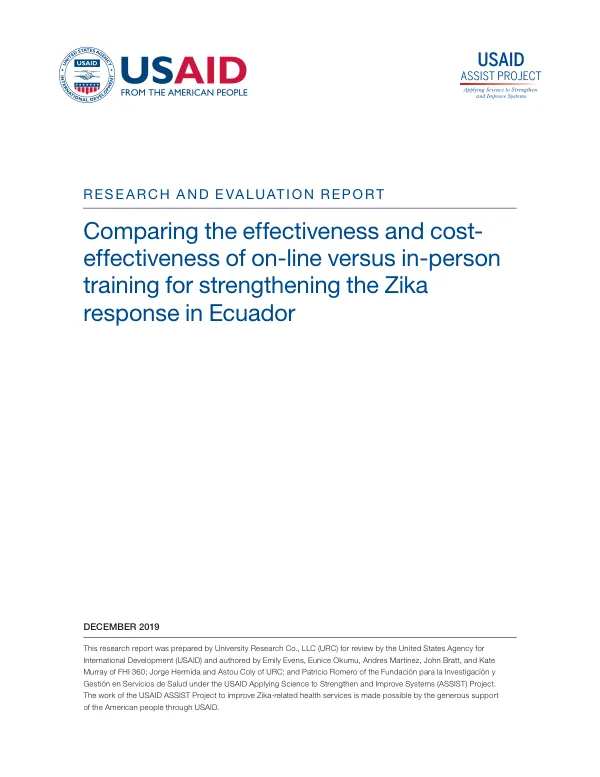
Comparing the effectiveness and cost-effectiveness of on-line versus in-person training for strengthening the Zika response in Ecuador
Sign inENCOMPASS, LLC
Comparing the effectiveness and cost-effectiveness of on-line versus in-person training for strengthening the Zika response in Ecuador
The Zika response in Ecuador was strengthened through training programs implemented by the USAID Applying Science to Strengthen and Improve Systems (ASSIST) Project.
2019 · 34 pages
Sign in to readA free account is required to download.
Abstract
The project aimed to improve Zika-related health services, and training was a critical component of this effort. Two training modalities were compared: online health training (OHT) and face-to-face training (FTF). The study was conducted in Ecuador, with a target population of front-line health workers. The sampling strategy involved selecting a random sample of health workers from participating health facilities. Data were collected through a survey component and an economic analysis. The survey component assessed the socio-demographic characteristics of the participants, their knowledge of Zika, and their perceptions of the training. The economic analysis estimated the costs and cost-effectiveness of the two training modalities. The results of the survey showed that the participants had a good understanding of Zika, with a mean knowledge score of 80% at the pretest. However, there was a significant improvement in knowledge scores after the training, with a mean score of 95% at the post-test. The difference-in-difference estimates of the percentage of correct items from multilevel regression models showed that the online training was more effective than the face-to-face training in improving knowledge scores. The economic analysis showed that the online training was more cost-effective than the face-to-face training. The incremental costs of the online training were significantly lower than those of the face-to-face training. The study also found that the online training was more acceptable to the participants, with a higher satisfaction rate compared to the face-to-face training. The study had several limitations, including the small sample size and the limited generalizability of the results. However, the findings of the study suggest that online health training is a viable alternative to face-to-face training for strengthening the Zika response in Ecuador. The study recommends that the ASSIST Project consider scaling up the online training modality to reach a larger number of health workers. The Zika Knowledge Regression Model Results are presented in the appendix, which shows the results of the regression analysis of the knowledge scores. The model controlled for several variables, including the socio-demographic characteristics of the participants and the training modality. The results of the model showed that the online training was associated with a significant improvement in knowledge scores compared to the face-to-face training. The study's findings have implications for the development of training programs for health workers in the context of a health emergency such as the Zika epidemic. The results suggest that online health training is a cost-effective and acceptable alternative to face-to-face training, and can be scaled up to reach a larger number of health workers.
Related documents