USAID DEC
Comparison of abundance and diversity of invertebrates in sediments from CO2 and non-exposed reefs
Sign inUSAID DEC
Comparison of abundance and diversity of invertebrates in sediments from CO2 and non-exposed reefs
The study on the comparison of abundance and diversity of invertebrates in sediments from CO2 and non-exposed reefs was conducted by Karen Camille Perez and Ma.
2016 · 5 pages
Sign in to readA free account is required to download.
Abstract
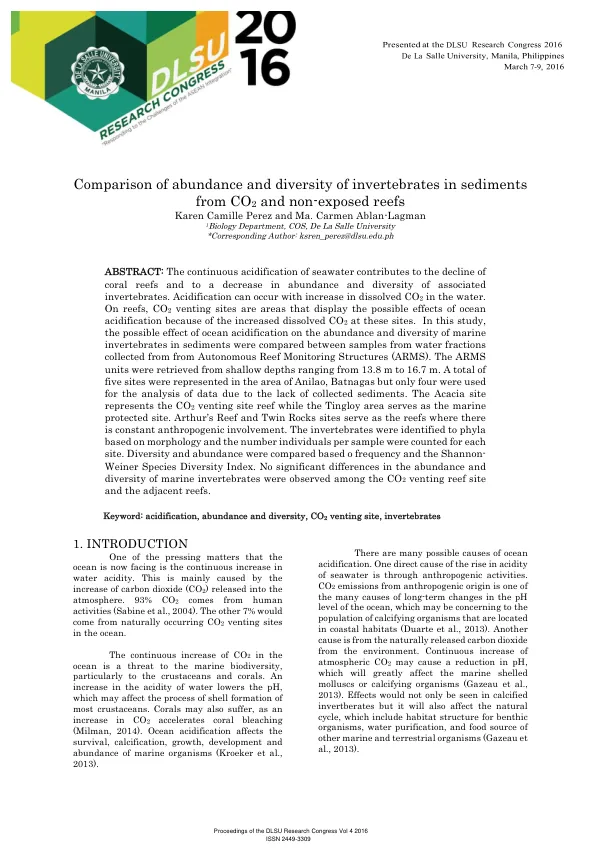
Carmen Ablan-Lagman from the Biology Department of De La Salle University. The research aimed to investigate the possible effects of ocean acidification on marine invertebrates in sediments from CO2 venting sites and adjacent reefs. The study was conducted in Anilao, Batangas, where four sites were selected for analysis: Acacia (BAO), a CO2 venting site; Tingloy (BAA), a marine protected area; Arthur's Reef (ART); and Twin Rocks (TWI). The Autonomous Reef Monitoring Structure (ARMS) units were retrieved from shallow depths ranging from 13.8 m to 16.7 m. The invertebrates were identified to phyla based on morphology, and the number of individuals per sample was counted for each site. The results showed that the site BAO, which was the CO2 venting site, contained the smallest number of organisms. However, the increase in the number of individuals from the non-CO2 venting reef sites compared to the CO2 venting reef site was not significant enough to indicate a relation between the acidification of the water and the decline in the number of organisms living there. The pH level across the reef sites remained basic, and the pH value from each reef site may be related to the season in which the ARMS units were retrieved. The Shannon-Wiener Diversity Index was used to check for the diversity of each site. The results showed that ART had the highest H value, making it the most diverse among the four sites. BAA, which was the marine protected area, obtained the lowest diversity. This may be due to the number of individuals living in the area. The study also compared the abundance of organisms among sites using the Paired-sample T-test. The results showed that there were no significant differences in the abundance of organisms among the CO2 venting reef site and the adjacent reefs. The Pearson Correlation Coefficient value in Table 2 also showed that there was no significant relation between the acidification of the water and the decline in the number of organisms living there. The study concluded that the pH level across the reef sites remained basic, and the pH value from each reef site may be related to the season in which the ARMS units were retrieved. The results also showed that the diversity of the invertebrate community was not significantly affected by the CO2 venting site. However, further studies are needed to investigate the long-term effects of ocean acidification on marine invertebrates in sediments from CO2 venting sites and adjacent reefs. The study's findings have implications for the conservation and management of coral reefs, particularly in areas where CO2 venting sites are present. The results suggest that the effects of ocean acidification on marine invertebrates may be more complex than previously thought, and that further research is needed to fully understand the impacts of this phenomenon on coral reef ecosystems.