USAID DEC
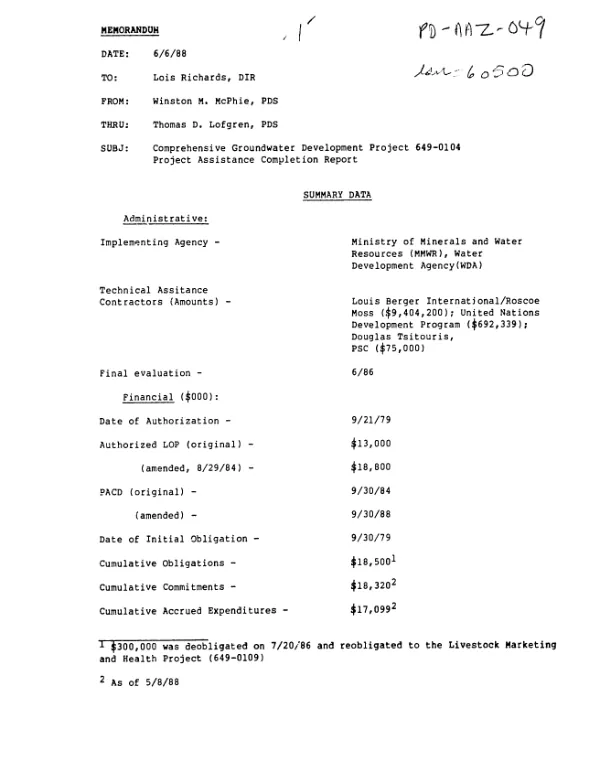
Comprehensive groundwater development project 649-0104 : project assistance completion report
Sign inLOUIS BERGER INTERNATIONAL, INC. (LBII) CENTER FOR RURAL DEVELOPMENT
Comprehensive groundwater development project 649-0104 : project assistance completion report
PACR of a project (9/79-9/88) to strengthen the management capability of Somalia"s Water Development Agency (WDA) and support establishment of an on-going rural water supply program.
McPhie, Winston M. · 1988
Sign in to readA free account is required to download.
Abstract
Results were mixed. Despite its technical accomplishments, the project failed to achieve major institutionalization objectives. A total of 142 boreholes were completed over the life of the project, but only 20 of these were commissioned by the WDA after the 6/86 departure of the contractor (vs. a planned capacity to commission 50 wells per year). Moreover, due to the WDA"s lack of operating funds, further private sector well-drilling has not been commissioned since the first four private wells were completed in 1987. A shortage of qualified Somali personnel constrained full institutionalization of the following components: an electronic and geophysical lab, a monitoring and evaluation system, and a planning unit. In addition, maintenance of well sites and pump and distribution systems is minimal to non-existent. On the positive side, the project provided degree and short-term U.S. geological training for 12 persons and effective on-the-job training for all project staff (about 132 in total) - although it is generally believed that continued inadequate pay (and for a period in 1987, actually no pay) will lead many trainees to leave the WDA for more lucrative employment. A National Water Center was established within the WDA and is now functioning relatively well with a library of more than 200 publications. Community participation was effectively encouraged through establishment of local water committees. The project also established a water quality lab, developed cost analysis models, and conducted studies on the potential for private sector water development and the future role of the WDA. Most importantly, socioeconomic studies indicate that conditions in target villages have improved considerably. Previously high rates of morbidity, mortality, and migration during seasonal water shortages have been minimized by project-constructed wells. Several lessons were learned. (1) Project design should more actively involve long-term staff members who are familiar with local conditions and, ideally, speak the local language. (2) The Mission should work more closely with other donors to address the standardization and local maintenance of vehicles and equipment. (3) Groundwater projects should consider not only quantitative needs but also the impact of alternative approaches on equipment needs, settlement patterns, future maintenance needs, and organizational structure. (4) Local participation in well development and operation should be included in all rural groundwater development projects. (5) The chances of successful project implementation are substantially reduced when authority is fragmented.