USAID. MISSION TO INDONESIA
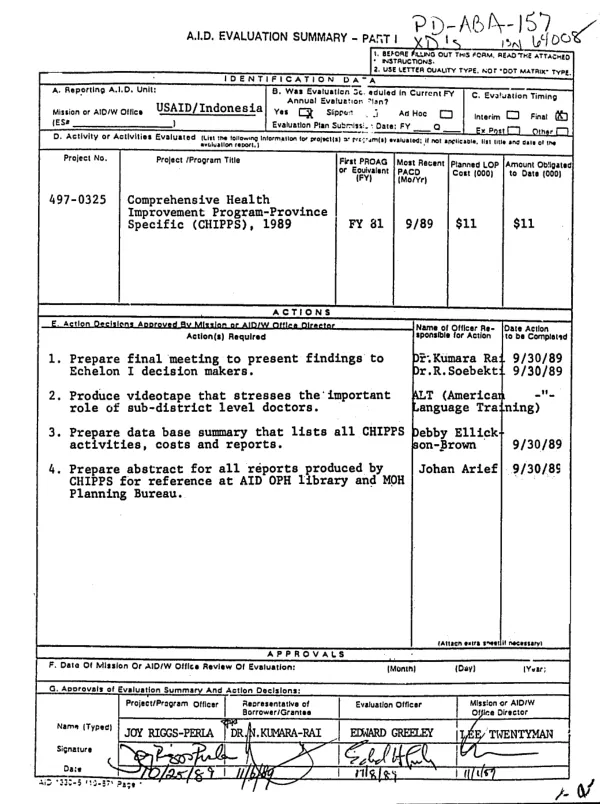
Comprehensive health improvement program project
Project to help the Government of Indonesia (GOI) upgrade health delivery in the outer island provinces of D.I.
1981
Sign in to readA free account is required to download.
Abstract
Aceh, Sumatra Barat and Nusa Tenggara Timur. The project will address quantitative and qualitative manpower needs and develop health officials" ability to design and implement needed services. The GOI Department of Health will implement the project. The project will provide both pre-service (290 trainees) and in-service (1,290) training for primary health nurses and nursing teachers (125), developing primary nurse training modules for each province; train villagers (500) and traditional midwives (450) as volunteer health/nutrition workers (and train their supervisors); and provide study tours, short courses, and/or on-the-job training to some 150 physicians, health center staff, village welfare movement workers, and district and provincial health/nutrition officials (officials will also receive academic training). Rural sanitarians (in Aceh and Nusa Tenggara Timur) and laboratory technicians/instructors (in Aceh only) will also be trained and community medicine education will be initiated in medical schools in Aceh and Sumatra Barat; medical school faculty will receive academic and short-term training and at Sumatra Barat the community medicine program will be integrated with health delivery. With the help of long- and short-term advisors, health personnel in each province will conduct a total of 5-10 epidemiological surveys (e.g., of protein-calorie malnutrition, nutritional anemia, goiter, diarrheal diseases, and tuberculosis); intervention trials, based on survey findings; and special studies (e.g., on the role of volunteers, the school health system, and tetanus immunization of pregnant women). Following the intervention trials, nutrition programs will be developed in all three provinces; a tuberculosis control program and a district-level diarrheal disease control program will also be developed in Aceh. The project will also establish simple vital statistics systems in one or two districts of each province, develop a data and management information system in Nusa Tenggara Timur, and conduct some 12 pilot projects on incorporating community health objectives into programs of the village welfare movement. Amendment of 6/85 extends the project three years and provides additional funding for continuation of long- and short-term TA; non-routine training, with focus on qualitative training to support the problem-solving emphasis central to the project; field studies and trials with special attention to innovative program interventions which follow-up quantification of health problems; policy meetings and seminars; and contingency. (PD-CAM-080)