USAID. MISSION TO INDONESIA
Comprehensive health improvement program -- province specific (CHIPPS), 1989
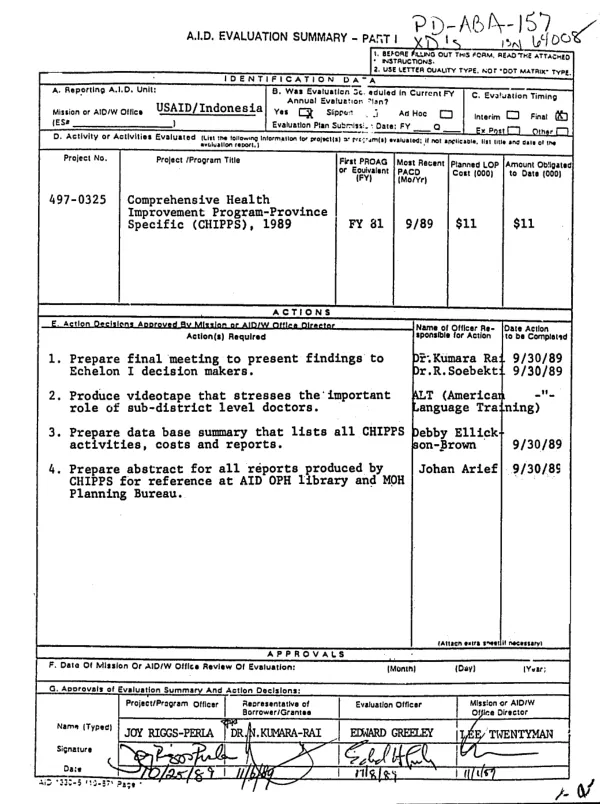
Summarizes final evaluation (XD-ABA-157-A/B) of a project to upgrade health delivery in Indonesia"s outer island provinces of Aceh, West Sumatra, and Nusa Tenggara Timur.
1989
Sign in to readA free account is required to download.
Abstract
The project focused on strengthening the ability of provincial and district health officials to design and implement needed services. Evaluation covered the period FY81-6/89 and emphasized the participation of key national level officials. The project was successful in improving the provinces" health service delivery system. Training activities (including community-based training of medical students and nurses, data management and epidemiological training, and other management training) were effectively implemented, and the participants were using the training in their daily work; planning, management, and information systems improved as a result. In addition, the project was cost effective. Some of the programs that were perceived as being expensive, such as the MONEV health information system, were at a level that could be reasonably absorbed by national or provincial budgets. The project demonstrated that developing provincial capabilities through a problem solving approach can result in a wide variety of useful activities that are effective at the provincial, district, and lower levels. However, the project also shows that the lack of involvement of national level officials can hinder replication of this approach. In fact, this evaluation wsa designed to overcome the lack of knowledge about project activities by involving key national Ministry of Health officials in all aspects of the evaluation. It is recommended that selected project activities be implemented on a national scale. Specifically, it is recommended that: (1) the MONEV health information system for health posts be appended to the national integrated health information system after gaining the coordinated support of other community level agencies; (2) data management training and other project management training efforts be integrated into current in-service training programs; (3) the project"s drug management activities be incorporated into a systematic effort that would include IEC, revised reporting forms, and assistant pharmicists; (4) the National Nursing Field Practice program be extended and reoriented to follow the project"s community-based model; (5) the Relawan Posyandu program, which placed unemployed recent nursing graduates in remote communities, be adopted nationally, with communities expected to provide funding through social insurance schemes; and (6) alternative project implementing units and block grant financing mechanisms be developed for national replication.