CHEMONICS
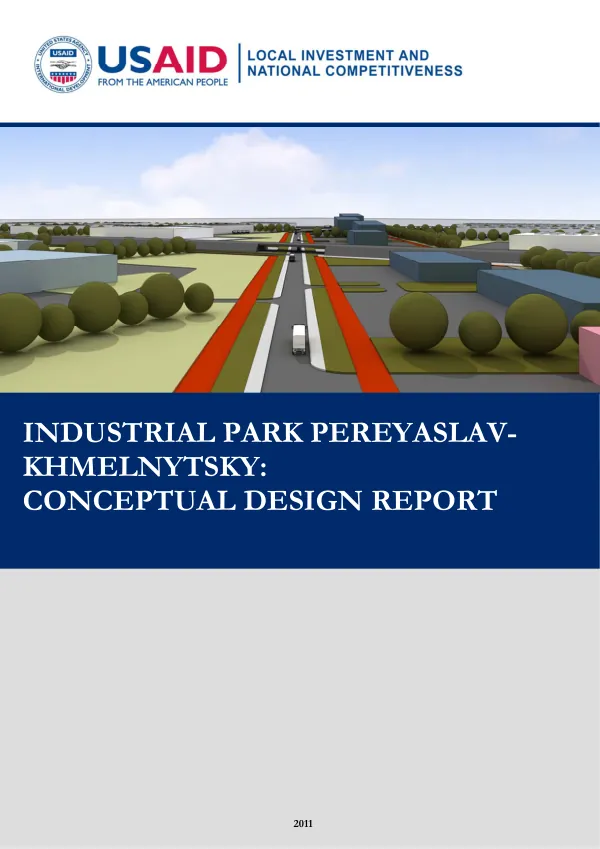
Conceptual Design Report: Industrial Park Lysychansk
The proposed industrial park in Lysychansk, Ukraine, aims to attract foreign direct investments (FDI) and create a more sophisticated production infrastructure.
2011 · 18 pages
Sign in to readA free account is required to download.
Abstract
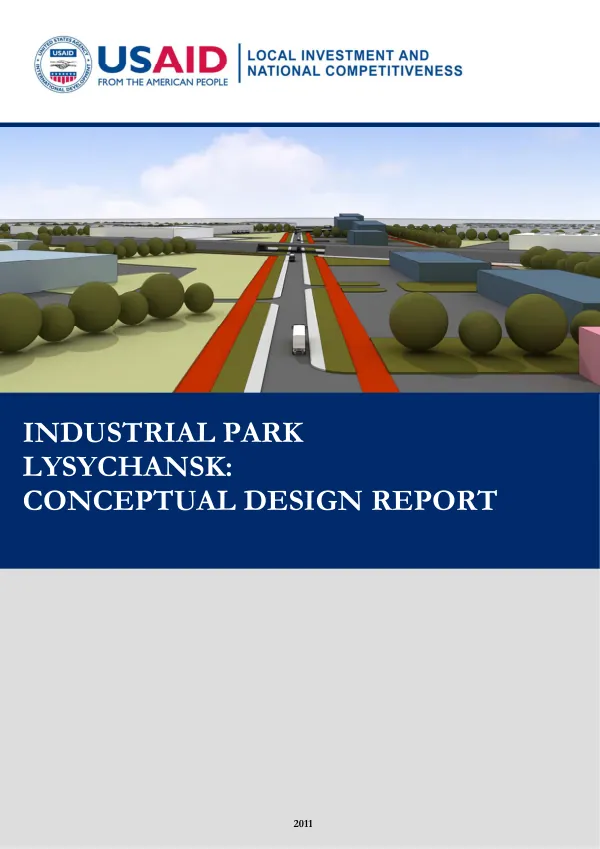
The development plan is based on the assumption that the Ukrainian national economy will continue to grow, generating a higher demand for advanced business locations. This demand is expected to be larger in industrialized agglomerations and important transport nodes, where both indigenous and international businesses are already established. The city of Lysychansk has a strong industrial history and tradition, with a population of 123,800 residents and a size of 9,600 ha. The city is located in the Donets Basin, a heavily industrialized region in eastern Ukraine, with a history in coal mining. Within a 30-kilometer radius, there is a population of about 300,000, including the neighboring city of Severodonetsk. The city has a sufficiently large labor force available, and the government of Lysychansk has an active role in supporting the development of a new industrial park and stimulating local economic development. The proposed industrial park will be located on a site of land that is suitable for the establishment of an industrial park of local/regional importance. The site is in the ownership of the city and has a size of too large to develop all at once, therefore a phasing is proposed. A conceptual plan is prepared on the land, which includes a typical industrial park of regional importance in Central Europe. The spatial parameters of the industrial park include a site with 40-80 ha of flat land, easy access to the site from the city, at least 150,000 inhabitants in the catchment area, no legal-ownership obstacles, and flexibility allowing a division into sub-sites/plots for different owners. The development plan includes a step-by-step development ensuring flexibility and opportunities to adapt to changing demands. The industrial park will accommodate industrial productive halls of various sizes, or flexible spatial combinations of these. A concrete plot offered to an investor will have to accommodate future extensions of the investor's production facility, ensuring that the initial development plan is not too intensive and some flexibility adjustment is kept when calculating energy demand. The industrial park will also have a maximum distance of ten kilometers to the highway/motorway of national (or at least regional) road network, and the possibility of having special services on site, such as a multifunctional center. The development of the industrial park is expected to attract FDI-companies, especially investments in production facilities, which will continue to move some of their operations from Western or Central Europe to the East. This is due to their mobility and the permanent need to seek the most cost-effective conditions to compete at global markets. It is assumed that this move will take place within the next 10-15 years and that Ukraine has the potential of playing a significant role as one of the "hot spots" in Eastern Europe. The development of the industrial park will also create a more sophisticated production infrastructure that will benefit both domestic Ukrainian producers and international investors. The infrastructure development needs, requirements, and assumptions for the industrial park include gas, electric energy, water, sewage water, surface water, and standard cross-section. The development costs and feasibility report, risk analysis, and follow-up actions identification are also included in the conceptual design report. The proposed industrial park in Lysychansk, Ukraine, is expected to create a more sophisticated production infrastructure and attract foreign direct investments. The development plan is based on the assumption that the Ukrainian national economy will continue to grow, generating a higher demand for advanced business locations. The industrial park will accommodate industrial productive halls of various sizes, or flexible spatial combinations of these, and will have a maximum distance of ten kilometers to the highway/motorway of national (or at least regional) road network.
Related documents