USAID DEC
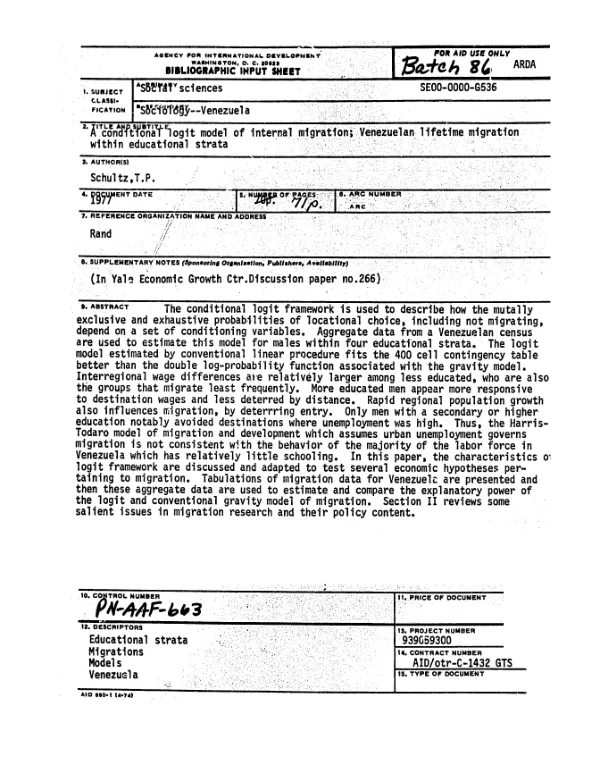
CONDITIONAL LOGIT MODEL OF INTERNAL MIGRATION; VENEZUELAN LIFETIME MIGRATION WITHIN EDUCATIONAL STRATA
Sign inRAND CORP.
CONDITIONAL LOGIT MODEL OF INTERNAL MIGRATION; VENEZUELAN LIFETIME MIGRATION WITHIN EDUCATIONAL STRATA
The conditional logic framework is used to describe how the mutually exclusive and exhaustive probabilities of locational choice, including not migrating, depend on a set of conditioning variables.
SCHULTZ, T. P. · 1970
Sign in to readA free account is required to download.
Abstract
Aggregate data from a Venezuelan census are used to estimate this model for males within four educational strata. The logic model estimated by conventional linear procedure fits the 400-cell contingency table better than the double log-probability function associated with the gravity model. Interregional wage differences are relatively larger among less educated, who are also the groups that migrate least frequently. More educated men appear more responsive to destination wages and less deterred by distance. Rapid regional population growth also influences migration, by deterring entry. Only men with a secondary or higher education notably avoided destinations where unemployment was high. Thus, the Harris-Todaro model of migration and development, which assumes urban unemployment governs migration, is not consistent with the behavior of the majority of the labor force in Venezuela which has relatively little schooling. In this paper, the characteristics of logic framework are discussed and adapted to test several economic hypotheses pertaining to migration. Tabulations of migration data for Venezuela are presented and then these aggregate data are used to estimate and compare the explanatory power of the logic and conventional gravity model of migration. Section II reviews some salient issues in migration research and their policy content.