USAID DEC
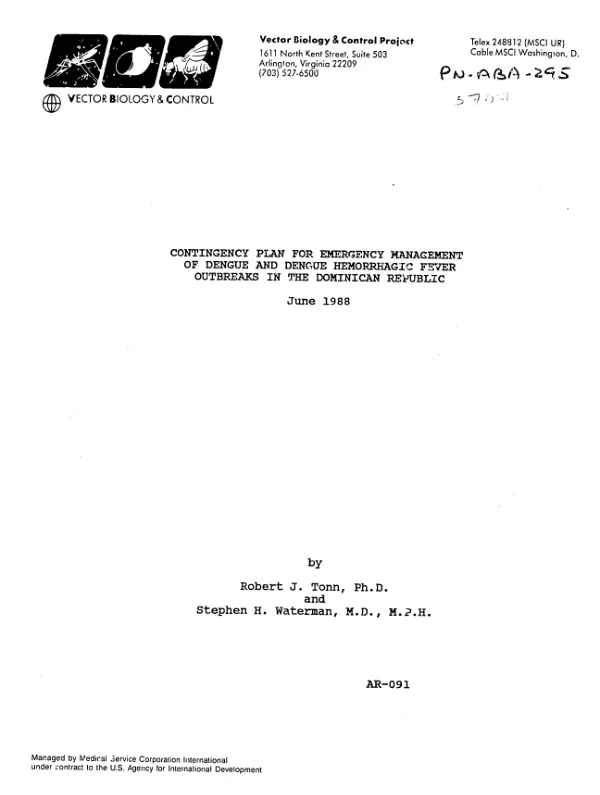
Contingency plan for emergency management of dengue and dengue hemorragic fever outbreaks in the Dominican Republic
Sign inMEDICAL SERVICE CORP. INTERNATIONAL
Contingency plan for emergency management of dengue and dengue hemorragic fever outbreaks in the Dominican Republic
Consultants from A.I.D."s Vector Biology Control Project helped USAID/Santo Domingo have developed a contingency plan for emergency control of dengue outbreaks in the Dominican Republic.
Tonn, Robert J.; Waterman, Stephen H. · 1988
Sign in to readA free account is required to download.
Abstract
Dengue fever, an acute febrile illness caused by four serotypes of the mosquito-borne dengue virus, is endemic in the Caribbean region. Dengue epidemics have occurred in the Caribbean with increasing frequency over the past 25 years and sporadic cases of dengue hemorrhagic fever/dengue shock syndrome (DHF/DSS), a severe form of the disease, have been documented in several countries in the region. During an epidemic in Cuba in 1981, more than 100,000 people suffering from DHF/DSS were hospitalized over a five-month period. Dengue surveillance, which has begun recently in the Dominican Republic, indicates considerable dengue transmission and the circulation of at least three dengue serotypes. This circulation of multiple serotypes, combined with the presence of large populations of Aedes aegypti, a mosquito that transmits dengue, pose a serious threat of continued outbreaks and the emergence of DHF/DSS in the Dominican Republic. The contingency plan describes the medical emergency requirements and reviews the surveillance, inventory and procurement of supplies, community education efforts, and other activities necessary for emergency control of dengue outbreaks. (Author abstract)
Connected topics