INTERNATIONAL STATISTICAL INSTITUTE
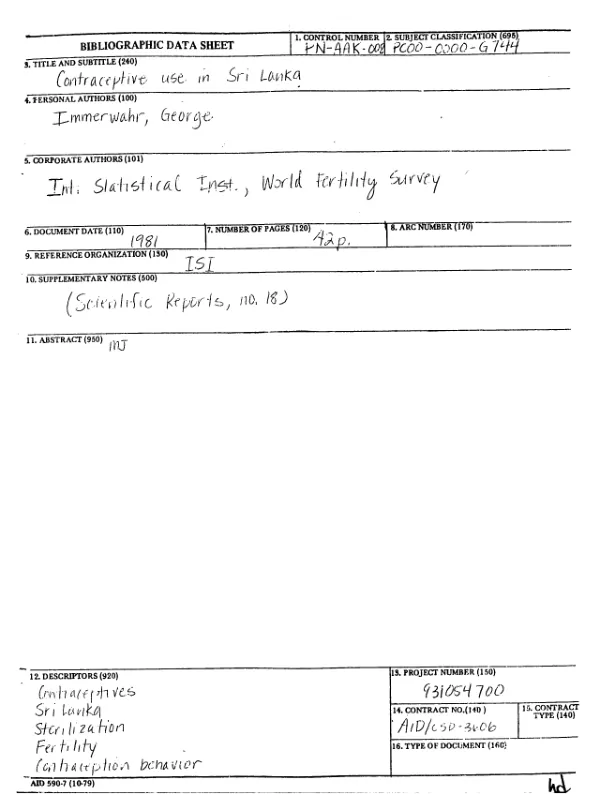
Contraceptive use in Sri Lanka
Contraception, according to some scholars, now matches the increasing age of women at marriage as a cause of Sri Lanka"s declining crude birth rate.
Immerwahr, George E. · 1981
Sign in to readA free account is required to download.
Abstract
This study analyzes data from the Sri Lanka Fertility Survey not published in the Survey"s First Report in order to identify the determinants of contraceptive use and to estimate the births averted by female sterilization, Sri Lanka"s main contraceptive method (CM). Discussed in turn are the use of modern reversible CM"s (the pill, IUD loop, and condom); female sterilization; year of use of reversible CM"s or sterilization; CM first used; a comparison of Survey results with data from the Sri Lanka Family Health Bureau; the reasons for non-use and determinants of ever-use of contraception; current contraceptive use (using multivariate analysis); and the effect of contraception on fertility. The following conclusions were reached: (1) While contraception is a growing force in Sri Lanka, delay in age of marriage is a still greater cause of the country"s declining birth rate. (2) Modern CM"s are widely known, but are actually used by only a minority of exposed women. The reasons given for non-use are seldom convincing. (3) The loop has a fairly good retention record, but the record of the pill is poor, partly because of problems in support of its use. (4) Female sterilization protects as many exposed women as all other CM"s combined and averts a substantial number of births. In general, women who had been sterilized had particularly high fertility in the years preceding sterilization and had used no previous method of contraception. (5) There has been a considerable shift from traditional to modern CM"s. (6) There is a significant geographical and ethnic variation in contraceptive use. Use is highest in the capital, Columbo, and is relatively high in the central highland area (although not in the tea estates). Use is much less among the Tamils and Moors (who have, however, a lower fertility rate) than among the Sinhalese (especially Christian Sinhalese) and varies strongly and directly with female education. (7) A woman"s fertility during the first 5 years of marriage appears to be a key determinant of contraceptive use. A 17-item list of references (1968-80) is appended.