USAID DEC
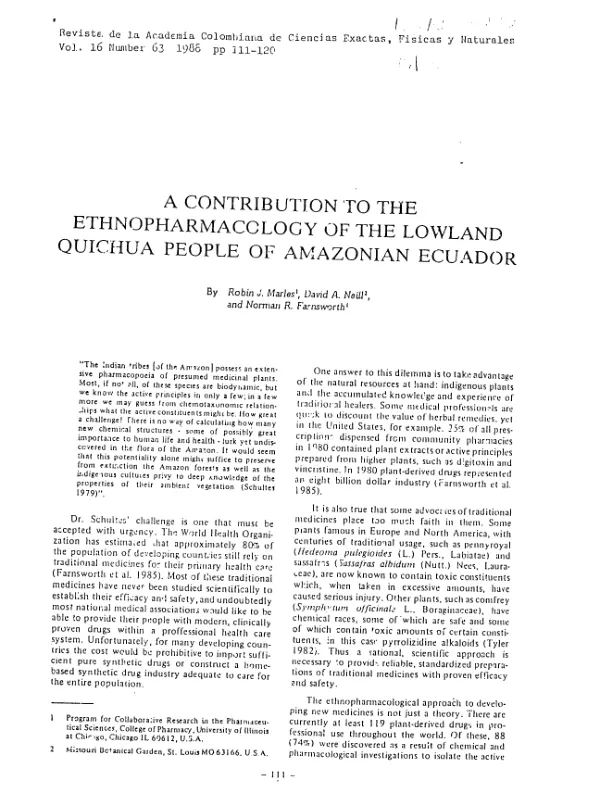
Contribution to the ethnopharmacology of the Lowland Quichua people of Amazonian Ecuador
Sign inUSAID. MISSION TO ECUADOR
Contribution to the ethnopharmacology of the Lowland Quichua people of Amazonian Ecuador
Field research was conducted on the traditional medicinal plants of the lowland Quijos Quichua people living in the Amazonian rain forest in eastern Ecuador.
Marles, Robin J.; Neill, David A. +1 more · 1970
Sign in to readA free account is required to download.
Abstract
Under the direction of Quichua medicine men, some 120 species of plants were collected. Of the 80 or more native uses of these medicines, by far the most common were for treating symptoms suggestive of parasitic infections; other common uses are for pain management, female fertility and its regulation, and as anti-venoms. An extensive review of the ethnobotanical, pharmacological, chemical, and toxicological literature provided substantial collaboration of the Quichua traditional medicines; in fact, correlations between the literature and the field results were 2-3 times what could be attributed to random chance, thus reaffairming the value of studying traditional medicines in order to discover new therapeutic agents or new local sources of therapeutic agents. In some cases, however, the literature contradicted Quichuan use or indicated toxicity. No particular medicinal plant, therefore, can be assumed to be both safe and effective; thorough evaluations are needed. Medicinal plants with proven safety and efficacy can then be incorporated into the pharmacopoeia of their native countries and the practice of primary health care. Included is a list of the medicinal plants, their families, scientific names, traditional uses, and an indication whether corroborating information is available.
Connected topics
Related documents