USAID DEC
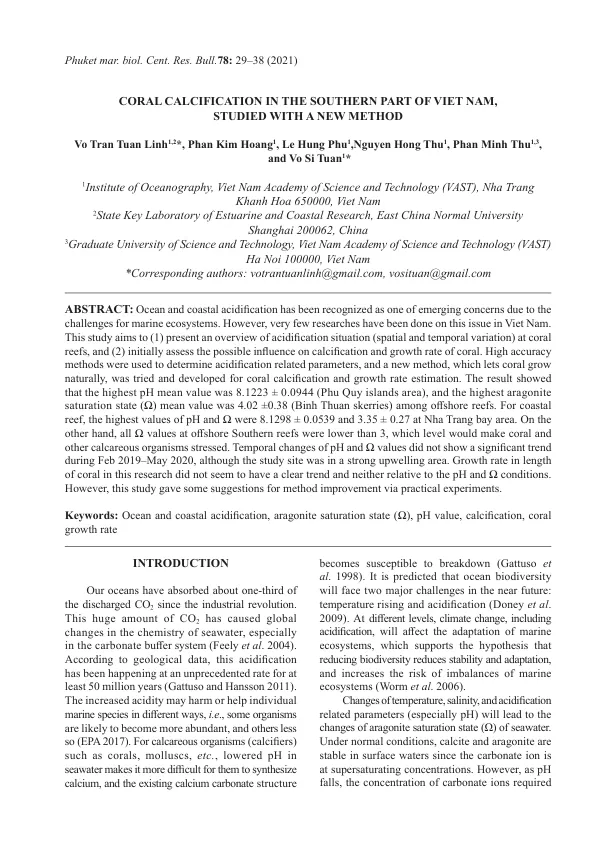
Coral Calcification in the Southern Part of Viet Nam, Studied with a New Method
Ocean and coastal acidification has been recognized as a significant concern due to its impact on marine ecosystems.
2021 · 10 pages
Sign in to readA free account is required to download.
Abstract
The increased acidity of seawater affects the ability of calcareous organisms, such as corals, to synthesize calcium and maintain their calcium carbonate structures. This study aimed to present an overview of the acidification situation at coral reefs in South Viet Nam and assess the possible influence on coral calcification. The study collected water samples from 2018 to 2020 in three coastal areas and six offshore areas. The pH of seawater was measured using a high accuracy method, and temperature and salinity parameters were measured in situ. Aragonite saturation values (Ω) were calculated using CO2sys software. Coral growth and calcification rate were investigated using a new method developed by the researchers. The results showed that the highest pH mean value was 8.1223 ± 0.0944 in the Phu Quy islands area, and the highest aragonite saturation state (Ω) mean value was 4.02 ± 0.38 in the Binh Thuan skerries area among offshore reefs. For coastal reefs, the highest values of pH and Ω were 8.1298 ± 0.0539 and 3.35 ± 0.27 in the Nha Trang bay area. However, all Ω values at offshore Southern reefs were lower than 3, which would make coral and other calcareous organisms stressed. The study also investigated the relationship between coral calcification and related acidification parameters. Coral branches of the species Acropora muricata and Acropora robusta were marked, measured, and left for continued growth. The new length of the coral branches was measured after 30 days, and the difference was calculated as the growth in length of coral. The calcification rate was calculated by subtracting the weight of calcium carbonate at the sampling from the initiation and dividing by the number of days. The results showed that there was no significant correlation between coral calcification and related acidification parameters. However, the study suggested that the new method developed by the researchers could be used to assess the relationship between coral calcification and acidification parameters in the future. The study also highlighted the need for further research on ocean and coastal acidification in Viet Nam, as there have been very few studies on this issue in the country. The study's findings have implications for the conservation and management of coral reefs in South Viet Nam. The results suggest that coral reefs in the region are vulnerable to ocean and coastal acidification, and that further research is needed to understand the impacts of acidification on coral calcification and other biological functions. The study's new method for assessing coral calcification and acidification parameters could be used to inform conservation and management efforts in the region.