CAROLINA POPULATION CENTER AT THE UNIVERSITY OF NORTH CAROLINA AT CHAPEL HILL
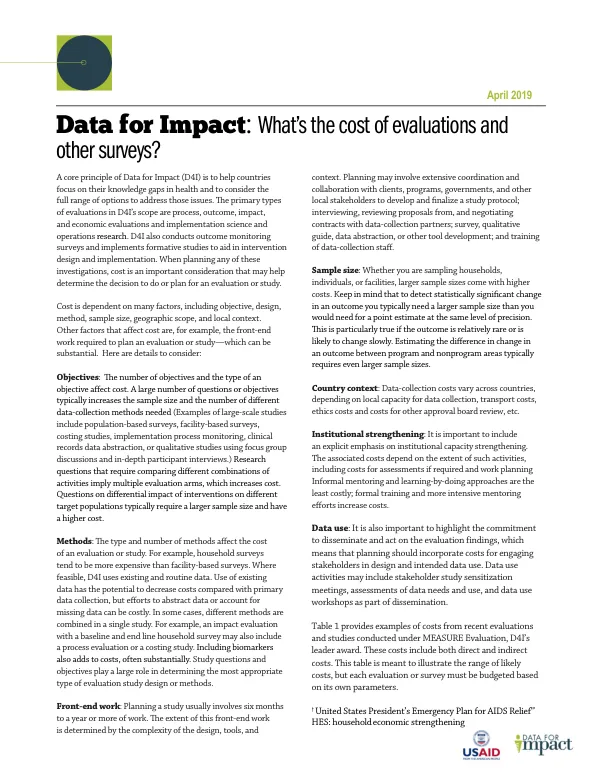
Cost Considerations for Evaluations and Surveys
Evaluations and surveys for measuring the impact of programs and projects on various outcomes, such as education, economic, and health, can be costly due to several factors.
2019 · 2 pages
Sign in to readA free account is required to download.
Abstract
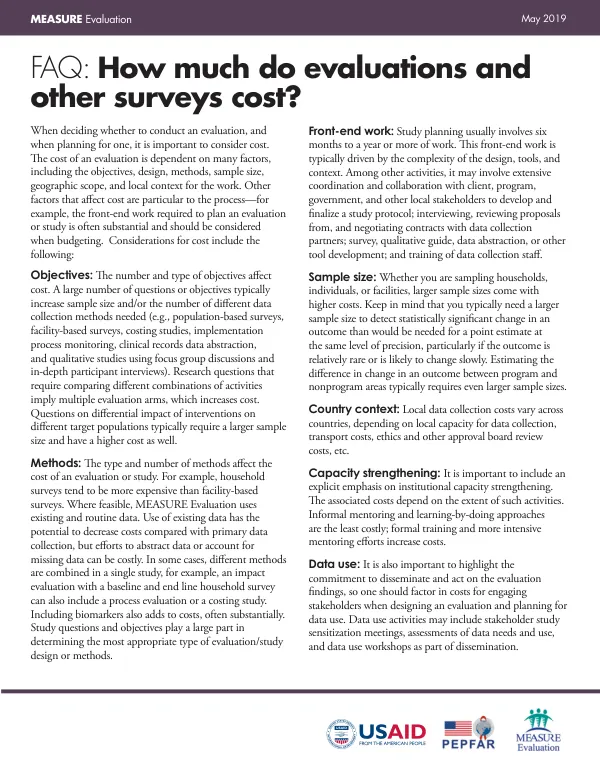
The cost of an evaluation or survey is influenced by the objectives, design, methods, sample size, geographic scope, and local context for the work. Objectives play a significant role in determining the cost, as a large number of objectives typically increase the sample size and/or the number of different data collection methods. For instance, questions that require comparing the impact of interventions on different target populations typically require a larger sample size and have a higher cost. The type and number of methods used in an evaluation or survey also affect the cost. Household surveys tend to be more expensive than facility-based surveys. MEASURE Evaluation often uses existing and routine data to decrease costs compared to primary data collection. However, efforts to abstract data or account for missing data can be costly. In some cases, different methods are combined in a single study, such as an impact evaluation with a baseline and end line household survey, which can include a process evaluation or costing study. Front-end work, which typically involves six months to a year or more, is a significant factor in determining the cost of an evaluation or survey. This work includes developing and finalizing a study protocol, interviewing and negotiating with data collection partners, survey and qualitative guide development, and training of data collection staff. Larger sample sizes also come with higher costs, as they require more resources and time to collect and analyze the data. Local data collection costs vary depending on the country's capacity for data collection, transport costs, ethics and approval board review, and other factors. Capacity strengthening is also an essential aspect of an evaluation or survey, and the associated costs depend on the extent of the activities. Informal learning-by-doing approaches are the least costly, while formal training and more intensive mentoring efforts increase costs. Data use is another critical aspect of an evaluation or survey, and costs should be factored in for engaging stakeholders and planning for data use activities, such as stakeholder study sensitization meetings, assessments of needs and use, and data use workshops as part of dissemination. Examples of evaluation and survey costs are provided in Table 1, which illustrates the range of costs for various studies conducted under MEASURE Evaluation. The costs vary depending on the specific study design, methods, sample size, and geographic scope, among other factors. The Botswana Youth Orphan and Vulnerable Children (OVC) Evaluation, for instance, had a budget of $1,436,236 and involved a mixed methods outcome evaluation to determine whether OVC beneficiaries who received services from both the US Government and the Government of Botswana had better education, economic, and health outcomes than those who received services only from the Government of Botswana. The study design for the Evaluation of Services for Vulnerable Populations (ISVP) in Rwanda was a prospective, controlled trial using difference-in-differences estimation with fixed effects modeling to evaluate program impact on economic, health, and education outcomes. The cost of this study was $2,156,362 and included a baseline and end line population-based survey with four questionnaires and a sample size of 4,500. The Health Study in Kenya, Rwanda, Tanzania, and Tanzania, and the Health Study in Kenya, Rwanda, Tanzania, and Tanzania, and the Health Study in Kenya, Rwanda, Tanzania, and Tanzania, and the Health Study in Kenya, Rwanda, Tanzania, and Tanzania, and the Health Study in Kenya, Rwanda, Tanzania, and Tanzania, and the Health Study in Kenya, Rwanda, Tanzania, and Tanzania, and the Health Study in Kenya, Rwanda, Tanzania, and Tanzania, and the Health Study in Kenya, Rwanda, Tanzania, and Tanzania, and the Health Study in Kenya, Rwanda, Tanzania, and Tanzania, and the Health Study in Kenya, Rwanda, Tanzania, and Tanzania, and the Health Study in Kenya, Rwanda, Tanzania, and Tanzania, and the Health Study in Kenya, Rwanda, Tanzania, and Tanzania, and the Health Study in Kenya, Rwanda, Tanzania, and Tanzania, and the Health Study in Kenya, Rwanda, Tanzania, and Tanzania, and the Health Study in Kenya, Rwanda, Tanzania, and Tanzania, and the Health Study in Kenya, Rwanda, Tanzania, and Tanzania, and the Health Study in Kenya, Rwanda, Tanzania, and Tanzania, and the Health Study in Kenya, Rwanda, Tanzania, and Tanzania, and the Health Study in Kenya, Rwanda, Tanzania, and Tanzania, and the Health Study in Kenya, Rwanda, Tanzania, and Tanzania, and the Health Study in Kenya, Rwanda, Tanzania, and Tanzania, and the Health Study in Kenya, Rwanda, Tanzania, and Tanzania, and the Health Study in Kenya, Rwanda, Tanzania, and Tanzania, and the Health Study in Kenya, Rwanda, Tanzania, and Tanzania, and the Health Study in Kenya, Rwanda, Tanzania, and Tanzania, and the Health Study in Kenya, Rwanda, Tanzania, and Tanzania, and the Health Study in Kenya, Rwanda, Tanzania, and Tanzania
Related documents