USAID DEC
MEASURE Evaluation’s Contributions to the Implementation of DATIM and Leveraging DATIM Resources
Sign inCAROLINA POPULATION CENTER AT THE UNIVERSITY OF NORTH CAROLINA AT CHAPEL HILL
MEASURE Evaluation’s Contributions to the Implementation of DATIM and Leveraging DATIM Resources
The President's Emergency Plan for AIDS Relief (PEPFAR) aims to achieve epidemic control by taking effective interventions to scale, applying a continuous learning approach to program performance, and intensifying efforts to identify HIV/AIDS cases.
2019 · 2 pages
Sign in to readA free account is required to download.
Abstract
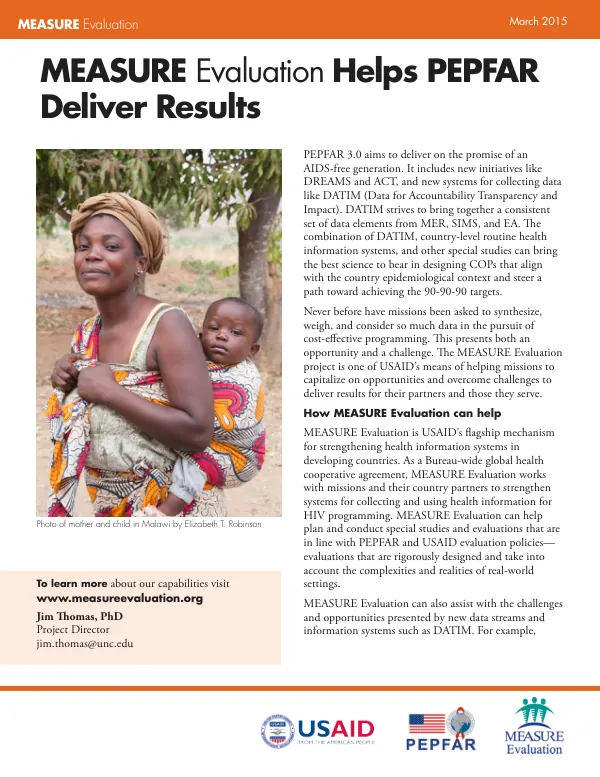
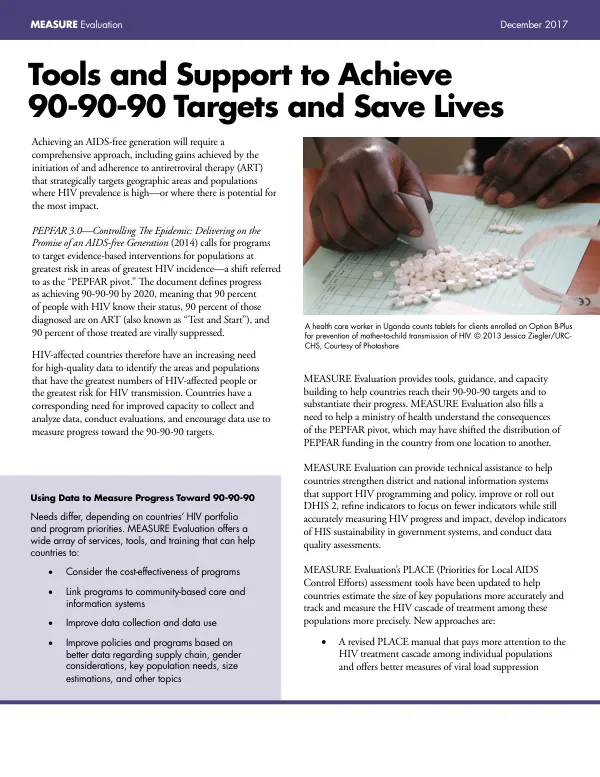
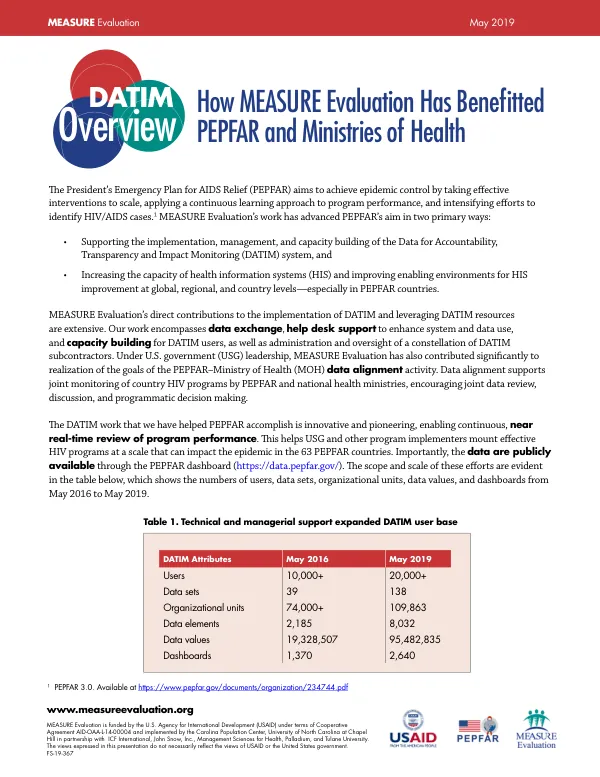
MEASURE Evaluation's work has advanced PEPFAR's aim in two primary ways: supporting the implementation, management, and capacity building of the Data for Accountability, Transparency and Impact Monitoring (DATIM) system, and increasing the capacity of health information systems (HIS) and improving enabling environments for HIS improvement at global, regional, and country levels—especially in PEPFAR countries. MEASURE Evaluation's direct contributions to the implementation of DATIM and leveraging DATIM resources are extensive. The organization has provided technical assistance for five DATIM training events, including a regional training in 2016, the PEPFAR Data and Systems Applied Learning Summit (PALS) in 2017, and the PEPFAR-MOH Data Alignment Virtual Workshop in 2018. These trainings improved USG capacity to use the DATIM system. MEASURE Evaluation has also managed Tier I, II, and III DATIM support, ensuring timely and high-quality responses to user queries, providing help desk support, updating guidance, and managing system security and compliance. The DATIM system has undergone significant improvements, with the number of users increasing from 10,000+ in May 2016 to 20,000+ in May 2019. The system's efficiency has also improved, with the number of new help-desk tickets decreasing from more than 3,000 in 2015 to an average of 300 in 2019. MEASURE Evaluation has also supported the development of an interoperable version of DATIM with automated data submission functionality, adding value to the OpenHIE stack and contributing significantly to improvements in PEPFAR's capability for interoperability. MEASURE Evaluation has also established and managed the PEPFAR Data Exchange Implementers Community, which supports USG agencies and implementing partners (IPs) to import their Site Improvement through Monitoring (SIMS) and Monitoring, Evaluation, and Reporting (MER) data into DATIM. The community has successfully supported data import into DATIM since 2015 and built USG and IP capacity to prepare and submit import files. As of May 2019, nine IPs and two USG offices import MER data into DATIM. The PEPFAR-MOH data alignment activity has also been a key focus area for MEASURE Evaluation. The organization has supported USG and MOH staff in 23 countries to complete PEPFAR-MOH data alignment, including mapping indicators, reconciling facility lists, and exchanging data between PEPFAR and MOH systems. To date, 18 of 23 countries have completed all data alignment milestones, including data sharing. MEASURE Evaluation has also conducted a three-week workshop with all 23 participating countries through the PEPFAR Virtual Academy and supported testing and application of the Facility Reconciliation tool to align PEPFAR-MOH health facilities. The data alignment activity has enabled site-level analysis to identify and resolve discordance between MOH and PEPFAR results for indicators at the site level, to identify overarching issues affecting data quality and completeness, and inform ongoing conversations with country teams and MOHs. The data alignment activity has also enabled countries to understand the full data landscape and inform best approaches to reach epidemic control, collate facility-level data on key indicators throughout the country, build efficiencies by strengthening national systems, emphasize system interoperability, and work towards the "collect once, use multiple times" paradigm.
Related documents