MEDICAL SERVICE CONSULTANTS, INC.
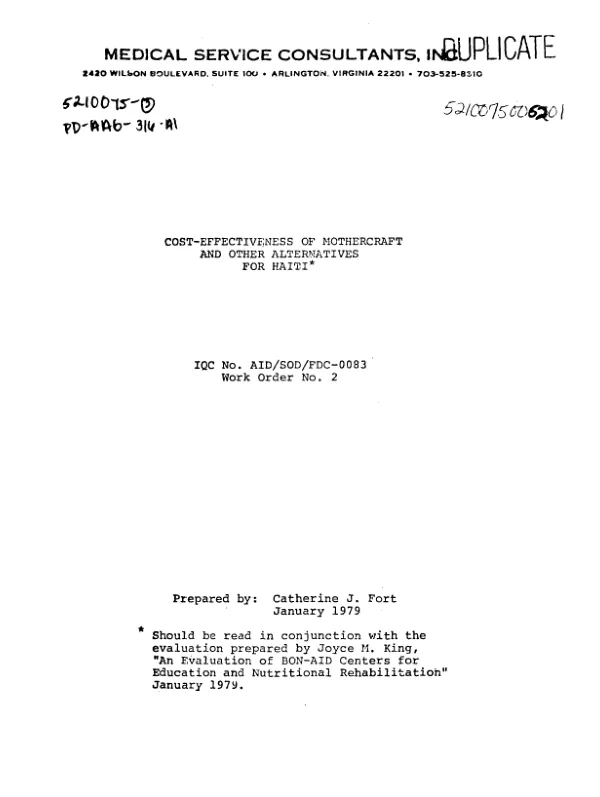
COST-EFFECTIVENESS OF MOTHERCRAFT AND OTHER ALTERNATIVES FOR HAITI
This special study, attached to a PES (PD-AAF-559-A1), assesses the cost-effectiveness of mothercraft centers and other nutrition intervention strategies in Haiti.
FORT, CATHERINE J. · 1979
Sign in to readA free account is required to download.
Abstract
It should be read in conjunction with a special evaluation (PD-AAF-559-A1). The study evaluates various interventions based on the following criteria: capability of the strategy, number of participants per center, cost per recuperated child and educated mother, changes in percent of standard weight for age, and mortality rates. The author develops a cost-effectiveness rating for each of the five strategies commonly used in Haiti: nutrition rehabilitation and education centers (CERN's); Hacho centers; Church World Service (CWS) centers; projet integre (foyer and nutrition centers); and hospital rehabilitation. Despite a lack of the detailed data needed for a thorough cost effectiveness study, the following conclusions are drawn. Hospital rehabilitation is the most expensive strategy, followed by CERN, Hacho, projet integre, and CWS. The author's major conclusion is that, based on the number of benefits per dollar spent, the CERN program -- the one most emphasized by the Bureau of Nutrition (BON) -- is the least cost-effective method. Projet integre and CWS are not only the cheapest strategies, but produce lower mortality rates among 1-4 year olds, increased life expectancy, and a higher rehabilitation rate. Further study is recommended to ascertain that the foyer system used in projet integre is the most cost-effective. A discussion follows which examines the elements of each individual program and describes the ideal mix of components for effective nutrition intervention, including untried elements of programs which are currently being developed. These include integrating nutrition services into the rural health system and distribution of supplementary dry food. The final recommendation is that BON diversify its program and retract its current emphasis on CERN's. A more cost-effective program than any of the options now used would be a mobile center offering a range of nutrition and education interventions in the regions of greatest need.
Related documents