USAID DEC
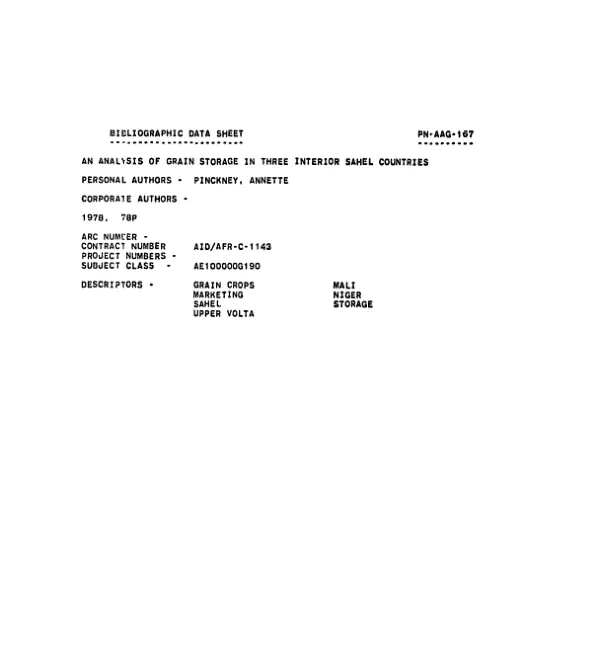
COSTS AND RETURNS OF SORGHUM AND MILLET PRODUCTION AND COSTS AND BENEFITS FROM SMALL AND MEDIUM SIZED IRRIGATED PERIMETERS IN THE SAHELIAN COUNTRIES; PROGRESS REPORT, 1977/1978
Sign inPURDUE UNIVERSITY. DEPT. OF AGRICULTURAL ECONOMICS
COSTS AND RETURNS OF SORGHUM AND MILLET PRODUCTION AND COSTS AND BENEFITS FROM SMALL AND MEDIUM SIZED IRRIGATED PERIMETERS IN THE SAHELIAN COUNTRIES; PROGRESS REPORT, 1977/1978
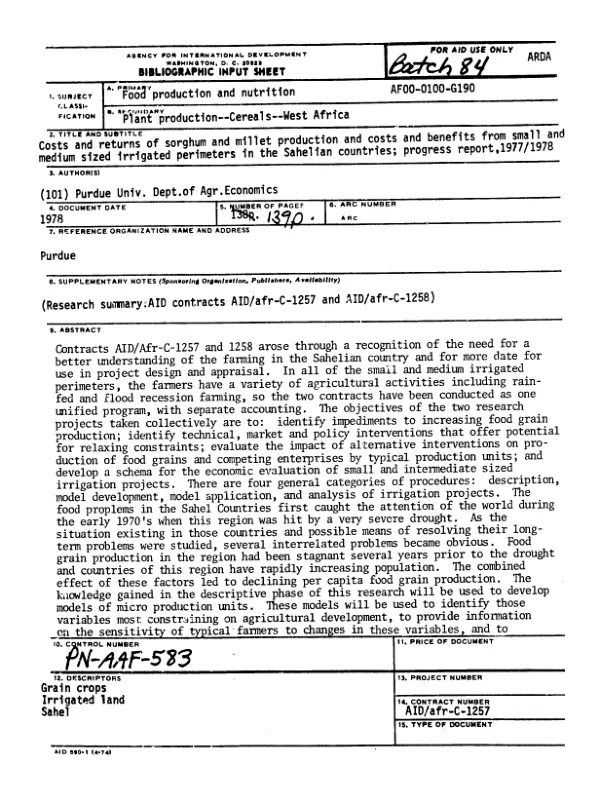
This project arose through a recognition of the need for a better understanding of the farming in the Sahelian country and for more data for use in project design and appraisal.
1970
Sign in to readA free account is required to download.
Abstract
In all of the small and medium irrigated perimeters, the farmers have a variety of agricultural activities including rainfed and flood recession farming, so the two contracts have been conducted as one unified program, with separate accounting. The objectives of the two research projects taken collectively are to: identify impediments to increasing food grain production; identify technical, market and policy interventions that offer potential for relaxing constraints; evaluate the impact of alternative interventions on production of food grains and competing enterprises by typical production units; and develop a scheme for the economic evaluation of small and intermediate sized irrigation projects. There are four general categories of procedures: description, model development, model application, and analysis of irrigation projects. The food problems in the Sahel Countries first caught the attention of the world during the early l970"s when this region was hit by a very severe drought. As the situation existing in those countries and possible means of resolving their long-term problems were studied, several interrelated problems became obvious. Food grain production in the region had been stagnant several years prior to the drought and countries of this region have rapidly increasing population. The combined effect of these factors led to declining per capita food grain production. The knowledge gained in the descriptive phase of this research will be used to develop models of microproduction units. These models will be used to identify those variables most constraining on agricultural development, to provide information on the sensitivity of typical farmers to changes in these variables, and to evaluate the likely impact of selective programs and policies on production of traditional food grains and competing crops.