ABT ASSOCIATES, INC.
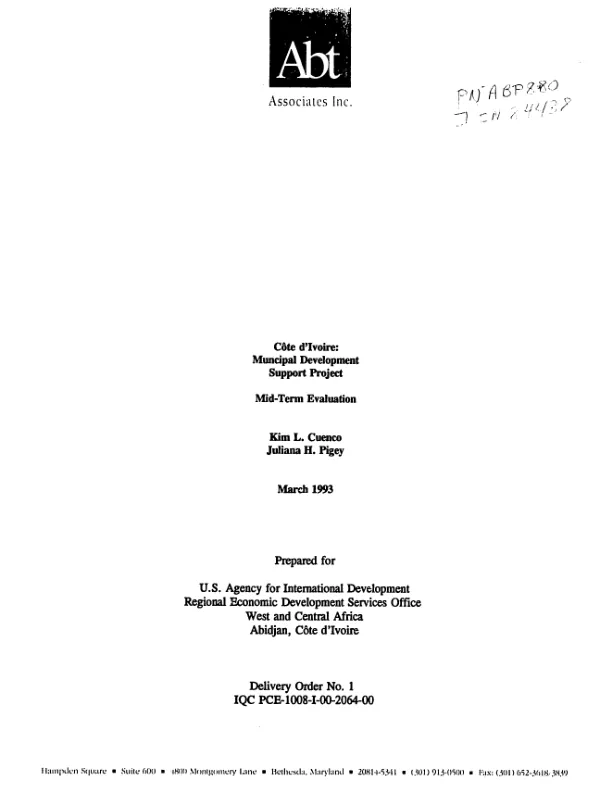
Cote d'Ivoire : municipal development support project -- mid-term evaluation
Evaluates project to strengthen management capacity in selected municipalities in the Ivory Coast through training, assistance with revenue enhancement, and facility construction.
Cuenco, Kim L.|Pigey, Juliana H. · 1993
Sign in to readA free account is required to download.
Abstract
Midterm evaluation covers the period 9/90-3/93. Progress -- particularly in revenue enhancement -- has been slowed by changes in the political and economic climate, major personnel turnovers, and institutional rivalry between the Ministry for Environment, Construction, and Urban Affairs and the Central Directorate for Public Works (DCGTx). However, efforts by project management to circumvent the institutional problems at DCGTx, along with continuing dialogue with mayors, should result in improved performance in phase II. The project's strongest feature is its relevance to the emerging needs created by rapid extension of the local government system in the Ivory Coast. The training strategy is particularly relevant because it provides technical training on-site, where the needs are most felt; this allows professionals to stay in the community instead of being sent to regional training centers. The sustainability of these onsite training efforts will require coordination with the management training being provided by the International Labor Organization. The major issue facing the project is sustainability, and specifically, the continued existence of the training unit. Neither the Directorate of Local Government nor the Ministry of the Interior have shown any institutional commitment to the unit, and given the government's financial problems, it is unlikely that they will. It is more realistic to expect financial support to come from either other donors buying in to the training program or from the municipalities themselves. However, privatization of the training unit will depend on two factors: that the trainers receive enough training and TA to enable them to respond to the emerging needs of municipalities in the decentralization process; and that the municipalities are able to identify their own training needs. With regard to planned participation in the training component by the Department of Social Development (DSS), sustainability will depend on the availability of local resources to support this initiative. Given the dim economic situation faced by local governments, it is unlikely that the municipalities benefiting from the project will have the resources to meet DDS requirements for housing a social center or for financing the social workers to manage community action groups.