USAID DEC
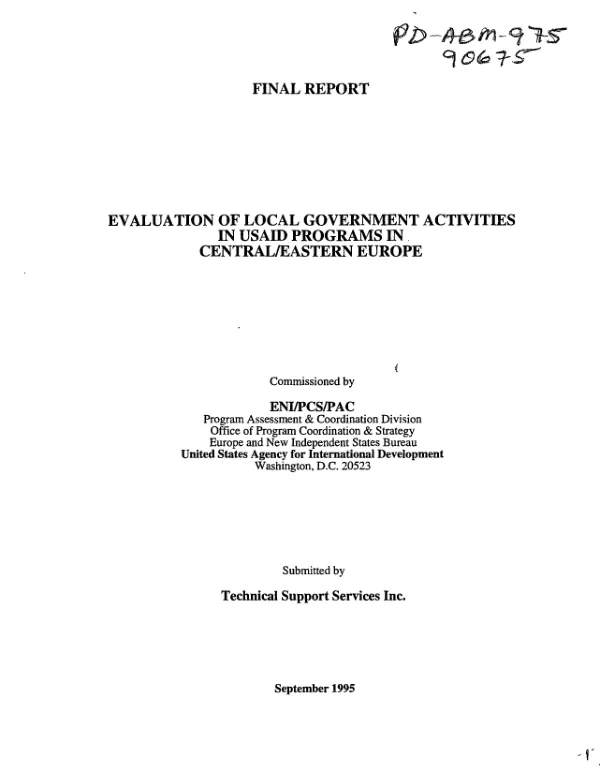
Evaluation of local government activities in USAID programs in Central/Eastern Europe
Sign inTECHNICAL SUPPORT SERVICES, INC. (TSS)
Evaluation of local government activities in USAID programs in Central/Eastern Europe
Evaluates the impact of activities in the housing/urban development, environment, energy, and privatization sectors on local governments in Bulgaria, Hungary, Poland, and Slovakia.
1995
Sign in to readA free account is required to download.
Abstract
Interim evaluation covers the period through 9/95. Four categories of TA appear to be the most needed by local governments as they emerge from a centralized, Communist-dominated environment: financial management; personnel/human resources management; intergovernmental relations; and service delivery. (1) Financial management. The pressing fiscal problems of most Central and Eastern European municipalities requires that high priority be given to financial management, and particularly to budgeting and resource mobilization. Systems such as accounting and auditing will take more time to develop, and more sophisticated techniques, such as performance measurement and productivity improvement, will take even longer -- although some steps, such as privatization of selected municipal services, can proceed more rapidly. (2) Personnel development. While the need to upgrade the technical capabilities of municipal managers and workers is of great importance, none of the assistance activities examined focused directly or principally on personnel development. Still, some important human resources strengthening activities were conducted, including support for a Polish training organization. (3) Intergovernmental relations. In Central and Eastern Europe, local government is a relatively new and weak participant in the intergovernmental structure. The centralizing tendencies of 40 years of communism only further emphasized the previous lack of a home rule tradition in most countries. For these countries, USAID has (correctly, in the view of this evaluation team) seen strengthening local government as a major means of strengthening democracy. However, no matter how strong local government can be made, it is likely to remain dependent for much of its resources and authority on central and/or regional governments. The fact that the central governments in Eastern Europe have very restrained enthusiasm for strengthening municipal governments (and countries have declared their direct opposition to enhanced home rule) also makes USAID's task a difficult one. (4) Service Delivery Improvement. Many USAID assistance efforts have focused on improving the quality and responsiveness of local services. In the view of the evaluation team, an important aspect of this assistance is whether it seems likely to have spin-off effects on other local government functions or other municipalities. The key recommendation is that USAID give highest priority to fiscal management; personnel management; and intergovernmental relations. Improving service delivery is also important, but it is difficult to ensure transferability across cities and among countries. (Author abstract, modified)