USAID DEC
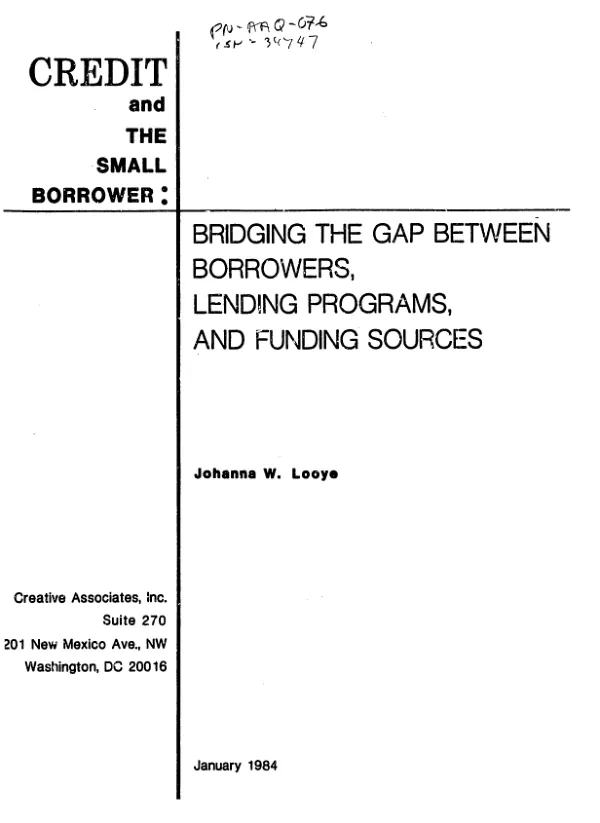
Credit and the small borrower : bridging the gap between borrowers, lending programs, and funding sources
Sign inCREATIVE ASSOCIATES INTERNATIONAL, INC. (CAII)
Credit and the small borrower : bridging the gap between borrowers, lending programs, and funding sources
Credit programs for small borrowers in developing countries encounter numerous difficulties - funds earmarked for small borrowers may not actually reach them, institutions offering such programs often are not viable, and development agencies find it difficult to directly supply small-borrower credit.
Looye, Johanna W. · 1984
Sign in to readA free account is required to download.
Abstract
Taking into account the constraints of large lenders and development funders, this paper examines methods for providing small borrowers with credit. Following a discussion of the problems involved in supplying funds to small borrowers through existing formal and informal channels, three alternative group-based credit mechanisms, which protect the lender"s institutional viability while providing credit, are presented: rotating savings and credit associations, revolving loan funds, and credit unions. Key issues that need to be considered in determining the appropriateness of each credit mechanism for a given financial market, community, and borrower are discussed. Next, the functional components common to most credit schemes are outlined and innovative options for the design and operation of credit programs are reviewed. Finally, three suggestions are offered for bridging the gap between the small borrower and the large lender: externalizing project costs; designing projects with growth potential; and providing credit with other types of assistance through a service agency. Two figures, four tables, and a 136-item bibliography (1939-83) are provided.
Connected topics
![Lessons from experience[, volume] II : the design and implementation of commercial lending projects by AID"s Bureau for Private Enterprise](https://covers.devme.ai/gen/14684.webp)