THE INTERNATIONAL REPUBLICAN INSTITUTE
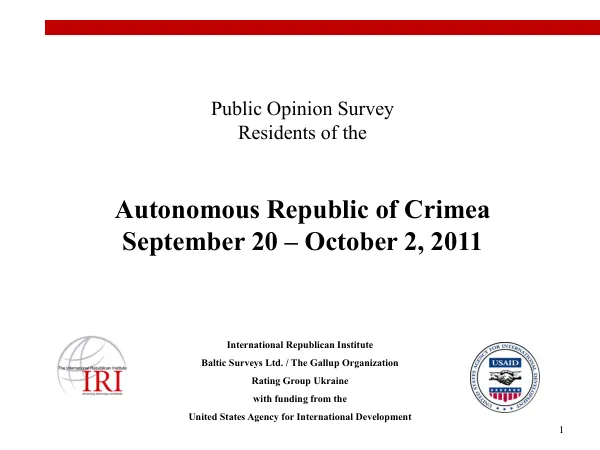
Crimea Residents Survey, September 2011
The survey of residents in the Autonomous Republic of Crimea was conducted from September 20 to October 2, 2011.
2011 · 53 pages
Sign in to readA free account is required to download.
Abstract
The sample consisted of 1,200 permanent residents of Crimea aged 18 and older, eligible to vote, and representative of the general population by age, gender, education, and religion. The survey was conducted in 61 settlements, including 26 urban and 35 rural ones, using a multi-stage random sample design. The survey found that 62% of respondents believed that things in Ukraine were going in the right direction, while 14% thought they were going in the wrong direction. When asked about their nationality, Ukrainians were more likely to believe that things were going in the right direction, with 67% of respondents identifying as Ukrainian expressing this view. In contrast, 57% of respondents identifying as Russian believed that things were going in the wrong direction. The survey also asked about the financial situation of respondents' households over the past 12 months. The results showed that 39% of respondents reported that their financial situation had worsened a lot, while 30% reported that it had stayed the same. When asked about their expectations for the next 12 months, 29% of respondents believed that the economic situation in Crimea would worsen a lot, while 24% believed that it would improve somewhat. In terms of national identity, 45% of respondents identified as Russian, 28% identified as Crimean, and 14% identified as Ukrainian. The remaining respondents identified as Crimean-Tatar, other nationalities, or did not know. The survey's findings provide insight into the attitudes and perceptions of residents in the Autonomous Republic of Crimea on various issues, including the direction of Ukraine, the financial situation, and national identity. The survey's methodology involved face-to-face interviews with respondents, and the response rate was 70%. The margin of error did not exceed 2.8%. The survey was conducted in the Autonomous Republic of Crimea, including the capital and all major regional centers, and the city of Sevastopol. The survey's findings are based on a representative sample of the general population, providing a comprehensive understanding of the attitudes and perceptions of residents in the region.