USAID. BUR. FOR PROGRAM AND POLICY COORDINATION. OFC. OF POLICY DEVELOPMENT AND PROGRAM REVIEW
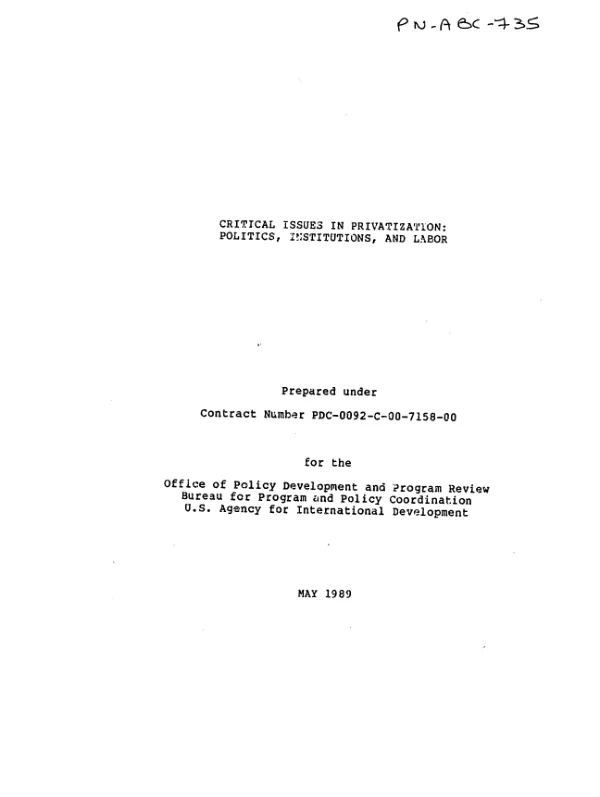
Critical issues in privatization : politics, institutions, and labor
Third World governments are increasingly aware of both the economic benefits of privatization and the complex problems and risks that accompany it.
Cowan, L. Gray · 1989
Sign in to readA free account is required to download.
Abstract
This study examines three potential problems raised by privatization programs. (1) Privatization is inherently political and therefore risky. While it is unlikely that political opposition can be entirely disarmed, experience in Jamaica and Costa Rica shows that it can be reduced to the point where it is no longer a serious threat to a major privatization program. (2) Successful privatization requires institutional change. Many existing structures - constitutional, regulatory, judicial, etc. - pose obstacles to privatization. But privatization also offers opportunities to increase skill levels in the concerned institutions. Privatization offices created to oversee the procedures offer their employees a knowledge of negotiations with the private sector they would otherwise not have. (3) A critical element in a privatization strategy is the labor force, which sees in privatization a loss of jobs, perquisites, and prestige as well as a threat to wage levels. If the government fails to calm these fears, the entire privatization program may be threatened. Conversely, persuading labor that the government takes its objections seriously and is endeavoring to meet them honestly and openly will go far toward public acceptance of privatization.