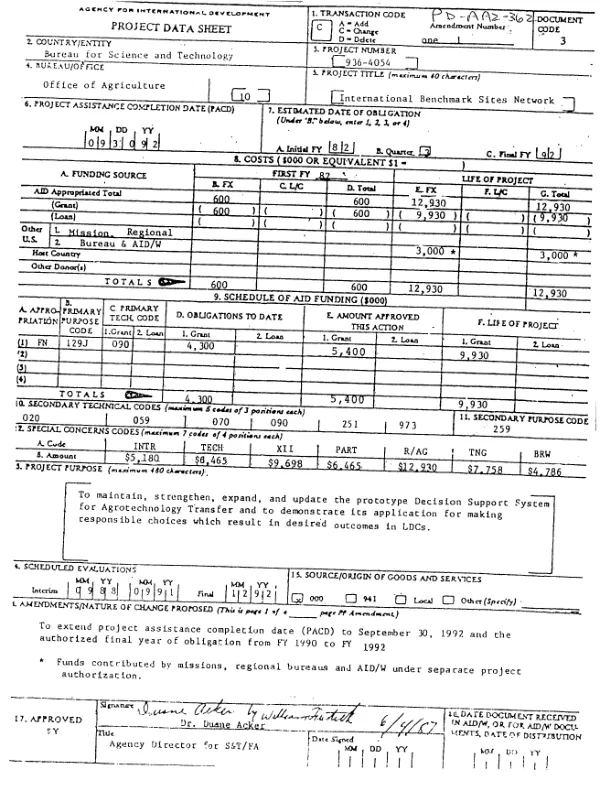
USAID. BUR. FOR SCIENCE AND TECHNOLOGY. OFC. OF AGRICULTURE
Crop nematode research and control
Project, follow-on to project 9310614, to improve LDC capacities to protect crops against nematode pests and to establish related pest management systems.
1970
Sign in to readA free account is required to download.
Abstract
A U.S. university will implement or coordinate the project"s collaborative research, training, and technology transfer components. As the core of a global research network, the U.S. team will collaborate with 6 International Agricultural Research Centers (IARC"s) and at least 15 LDC institutions; special efforts will be made to collaborate with ongoing A.I.D. research projects and to develop LDC capacities for independent research. Specifically, the U.S. university will screen 1,500 germplasm samples received from IARC"s and other LDC institutions for cultivars resistant to the eight common root-knot nematode (Meloidogyne) species and will screen 200 others for cultivars resistant to other nematode species; the 100 most resistant cultivars will be field tested and returned to IARC"s for use in ongoing breeding programs. The U.S. team will also work with LDC institutions to conduct onsite research in 7 LDC areas on 25 nematode problems in important crops and to evaluate cropping systems-related nematode management strategies on farmer plots at 16 locations; the environmental effects of nematocides will be carefully monitored in these efforts. To bolster LDC nematode management capacities, the project will provide short-term training to 10 LDC scientists and 15 research technicians at the U.S. university in relevant new techniques and will sponsor 8 in-country and/or regional training conferences and workshops on nematode management for 240 participants and 30 field demonstrations of nematode control techniques for 600 participants. Intensive one-on-one training of research network collaborators will also be offered. Finally, the U.S. university will act as an information clearinghouse on nematode issues, working with related A.I.D. projects to publicize and make available nematode literature to network collaborators, USAID"s, IARC"s, and farmers. The university will also publish a quarterly newsletter to nematologists worldwide and answer requests for TA in designing and equipping nematology laboratories (8 will be set up) and in such areas as research techniques, research project design, and data storage and analysis.
Related documents