USAID DEC
International benchmark sites network for agrotechnology transfer `IBSNAT" (project # 936-4054) : a pilot activity to facilitate rapid technology in the tropical and subtropical regions
Sign inUSAID. BUR. FOR SCIENCE AND TECHNOLOGY. OFC. OF AGRICULTURE
International benchmark sites network for agrotechnology transfer `IBSNAT" (project # 936-4054) : a pilot activity to facilitate rapid technology in the tropical and subtropical regions
Project, follow-on to 9310582 and 9310601, to facilitate agrotechnology transfer by establishing a pilot network of agricultural research institutions in the tropics and subtropics.
1981
Sign in to readA free account is required to download.
Abstract
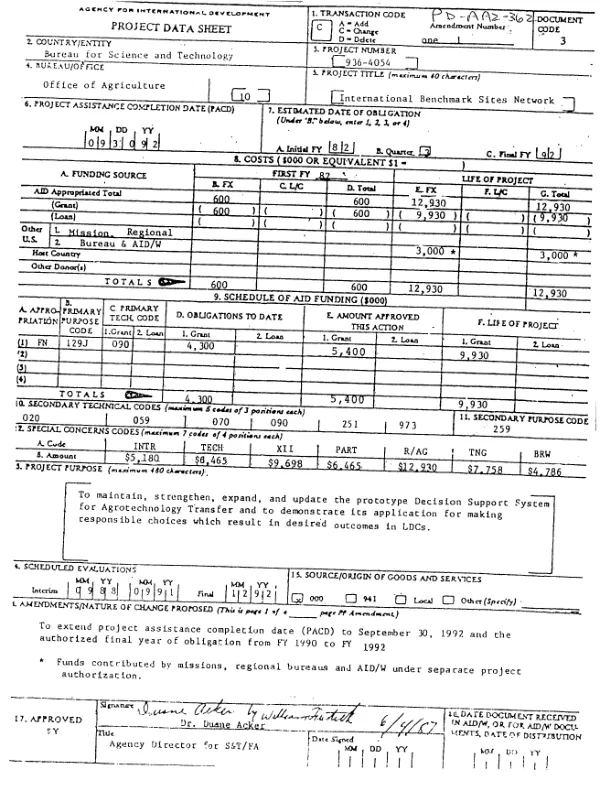
Participating institutions will conduct uniform, internationally coordinated studies to verify that agrotechnology can be transferred via a network approach. The University of Hawaii (UH) will be the lead implementor. The network will comprise 15-20 national, regional, and international agricultural research centers, including crop-oriented institutions such as CIAT, CIMMYT, ICARDA, and IITA; other A.I.D.-supported programs (e.g., CRIES, the Soil Management CRSP) may also participate. While TA and specialized equipment will be funded by the project, the centers will bear day to day research costs. The project"s research aim is to identify the particular soil and climatic characteristics that are needed for the successful production of particular crops. Emphasis will be on: (1) quantitative relationships between land qualities, soil management, crop requirements, and performance; (2) relationships between land qualities and soil classification parameters; and (3) the long-term effect of sustained crop performance on land degradation and production capacity. Crops to be studied may include maize, rice, wheat, sorghum and millet, potatoes, cassava, groundnuts, beans, cowpeas, and pigeonpeas. Specific research activities will include characterizing environmental conditions at participating centers; developing a standard methodology for determining soil, plant, and climate characteristics to be measured; and developing related crop models. A central computerized data bank (and perhaps related banks at the various centers) will be established to house data on soil and land characterization, crop performance under specific soil taxa, and weather. The project will also develop a systematic method for using computers to predict crop management needs under particular soil and land characteristics. The project will also: (1) conduct 3 workshops on the network approach (in Africa, Latin America, and Southeast Asia), provide training to help establish national networks, and arrange (not finance) project-related graduate training at various U.S. and European schools; (2) disseminate research information widely via workshops, written reports, audiovisuals, etc.; and (3) conduct 1-2 case studies of the viability of the project"s technology transfer approach. Amendment of 6/4/87 authorizes Phase II, and extends PACD to 9/30/92. New outputs will include: the coupling of pest, whole farm, and perhaps other models with crop models; strengthened data collection on the genetic coefficients of cultivars; academic training at UH and on-the-job training elsewhere; "expert systems" (i.e., sophisticated problemsolving computer programs); increased emphasis on application/demonstration and acceptance activities; and expanded network relationships. The amendment also authorizes buy-ins from Missions, Bureaus, and other A.I.D./W projects. (PD-AAZ-362)
Related documents