USAID. MISSION TO TUNISIA
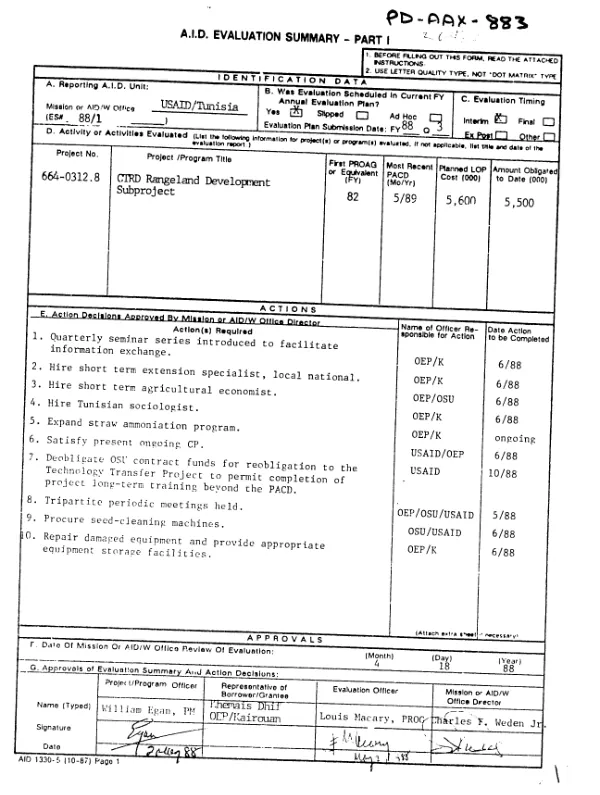
CTRD rangeland development subproject
Summarizes attached evaluation of project to develop a range management unit (RMU) in Central Tunisia and improve range management and stock raising practices among farmers.
1988
Sign in to readA free account is required to download.
Abstract
Mid-term evaluation covers the period 1982-88 and was based on document review, some 20 visits, and interviews with involved personnel and participating farmers. The project has made good progress. Its range interventions - reseeding, ripping, planting forest reserves, resting, and management - are effective measures for regenerating degraded lands. This can mean forage increases of three to five times when the interventions are done properly, although the increase depends in large part on the site - one reason why advance site research is crucial. Training, both long- and short-term, has been successful, and when the remaining 14 trainees return from degree training abroad next year, the RMU staff will be at full strength and ready to take full responsibility for continuing the project. The RMU has introduced a wide range of land improvement and animal health techniques to several thousand farmers over the last six years, but it is unclear whether these practices are being adopted by farmers over the long term. The project has learned that demonstrating technologies and having those technologies adopted are two very different things. Perhaps not enough was done to make sure the farmers understood the importance of what was being demonstrated. The straw ammoniation component promises to be an economically viable way to produce low-cost, nutritious source of roughage for animals and should be expanded, in the most cost-effective manner possible. The plant materials development component is on track, but more research is needed to identify those species most appropriate for Central Tunisia. Although the project has learned a great deal about range management in Tunisia, there is more to learn. Existing linkages with other projects and agencies in the area need to be strengthened and new ones developed. A small part of the project affects communal lands, where some farmers are unhappy because they have been prevented from harvesting and grazing the forage that has been grown. Basically, this problem can be charged to project staff"s lack of sociological expertise and to a clumsy administrative arrangement with the Directorate of Forestry (DOF). Recommendations are to hire a sociologist and an extensionist to better persuade farmers to adopt new technologies and to develop a better way of jointly managing with communities collective lands until a better arrangement with the DOF can be worked out. The lesson of this project is that farmers must be fully involved in planning, decisionmaking, and implementation if long-term change is to take place.