FEDERATION MINISTRY OF ENERGY, MINING AND INDUSTRY
Customary and Statutory Tenure in Africa
The Government of Liberia has recently adopted a new land rights policy, which grants unprecedented land rights to communities.
2016 · 4 pages
Sign in to readA free account is required to download.
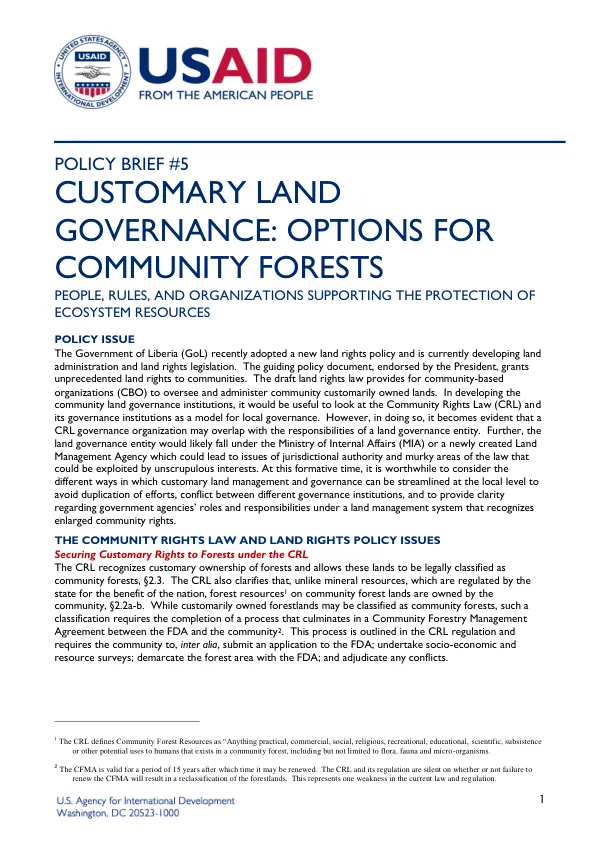
Abstract
The policy document, endorsed by the President, recognizes community customary rights over land and proposes to place these rights on par with private land rights. The policy defines customary land as land owned by a community and used or managed in accordance with customary practices and norms, and may include wetlands, communal forestlands, and fallow lands. The policy proposes that customary land ownership will be memorialized in deeds issued to legal entities representing the community, and management authority will rest in community representatives selected in a way to ensure equitable representation of all community members. The community's representatives' decision-making will be conducted in a way that ensures equitable representation and accountability to all community members. The policy also recognizes that this is an ambitious agenda and proposes that the government assist communities to self-define, obtain deeds, establish the community as a legal entity, demarcate boundaries, and put in place required governance and management procedures. To operationalize this policy, a Land Rights Act (LRA) has been drafted and presented to the legislature. The draft LRA has adopted the policy's definition for customary land and has strengthened further these rights by declaring that registration of rights is not a necessary precondition for enforcement of customary land rights. The draft LRA outlines a Confirmatory Survey process by which all land will be surveyed to determine the "size and boundaries" of each community's customary land. The community will be required to create a Community Land Development and Management Association (CLDMA) governed by by-laws and managed by an elected representative governing body. The CLDMA will be integrated in the official administration of the community in keeping with the Decentralization Policy of the Government. The Ministry of Lands, Mines and Energy (MLME) is responsible for approval, oversight, and regulation of mineral exploration and mining activities, while the Forestry Development Authority (FDA) is responsible for management of the country's forest estate, including commercial concessions, protected areas, and development and regulation of community forests. The Environmental Protection Agency is responsible for environmental regulatory compliance, and the National Bureau of Concessions is responsible for managing concession processes to ensure compliance. The policy options for customary land governance include the formation of a Community Land Development and Management Association (CLDMA) to oversee and administer community customary owned lands. However, this may overlap with the responsibilities of a land governance entity, and further, the land governance entity would likely fall under the Ministry of Internal Affairs (MIA) or a newly created Land Management Agency, which could lead to issues of jurisdictional authority and murky areas of the law that could be exploited by unscrupulous interests. The Community Rights Law (CRL) recognizes customary ownership of forests and allows these lands to be legally classified as community forests. The CRL also clarifies that forest resources on community forest lands are owned by the community, and a Community Forestry Management Agreement (CFMA) must be established between the FDA and the community to classify customary land as community forest. The CFMA is valid for a period of 15 years after which time it may be renewed, but the CRL and its regulation are silent on whether or not failure to renew the CFMA will result in a reclassification of the forestlands. The CRL also requires the community to form a representative governance institution prior to classification of customary land as community forest through a CFMA. This process involves the election of a Community Assembly (CA) and an Executive Committee (EC), the adoption of a Constitution and by-laws to govern the activities of the CA, and the appointment of a 5-member Community Forest Management Body that is responsible for the day-to-day governance and management of the community forest.