USAID
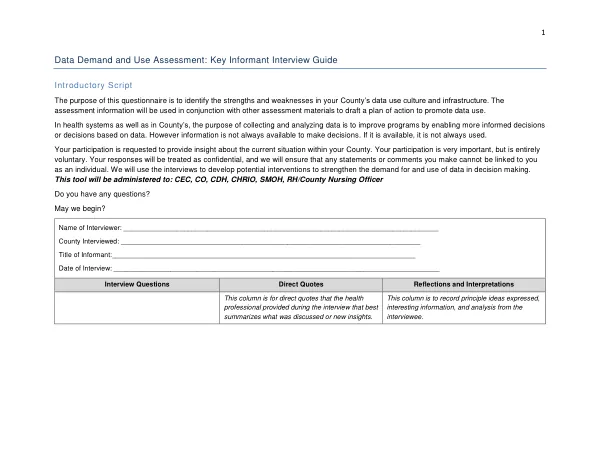
Data Demand and Use Assessment: Key Informant Interview Guide
Data Demand and Use Assessment in Counties: Key Informant Interview Guide The purpose of this assessment is to identify the strengths and weaknesses in a County's data use culture and infrastructure.
2021 · 6 pages
Sign in to readA free account is required to download.
Abstract
The assessment information will be used in conjunction with other materials to draft a plan of action to promote data use. In health systems and Counties, the purpose of collecting and analyzing data is to improve programs by enabling more informed decisions. However, information is not always available to make decisions, and even when it is available, it is not always used. County officials, including CEC, CO, CDH, CHRIO, SMOH, and RH/County Nursing Officer, will be administered this tool to provide insight about the current situation within their County. Participation is entirely voluntary, and responses will be treated as confidential. The interviews will be used to develop potential interventions to strengthen the demand for and use of data in decision making. The assessment focuses on the different types of program decisions made in the County, including decisions related to service provision, resource allocation, and planning for new activities. Officials are involved in the decision-making process, relying on various sources of information, including data. However, the availability and quality of data can be a significant obstacle to informed decision making. County officials are asked to provide examples of times when they consulted data to inform a decision about a health service or program. They are also asked to describe the current County plans, policies, procedures, or guidelines related to the collection, review, or use of data. The assessment also explores the data review process in the County, including how often data is reviewed, who is involved, and what comes out of these review meetings. The assessment identifies the biggest obstacles to data use in the County, including organizational challenges, technical ability, and behavioral factors. Officials are also asked to describe how they identify the data needed to make a decision, how they access that data, and what they do if they don't have the data they need. The data quality in the County is assessed in terms of accuracy, timeliness, and completeness of the information available from both routine and non-routine sources. Officials are responsible for managing data and assuring data quality within the County, but data quality issues can arise due to various causes. The assessment also explores the capacity within the County to collect, analyze, review, and use data for decision making, including the types of technical assistance received in the past 12 months. Overall, the assessment aims to identify the strengths and weaknesses in a County's data use culture and infrastructure, with the goal of promoting data use and improving decision making.