PALLADIUM INTERNATIONAL, LLC
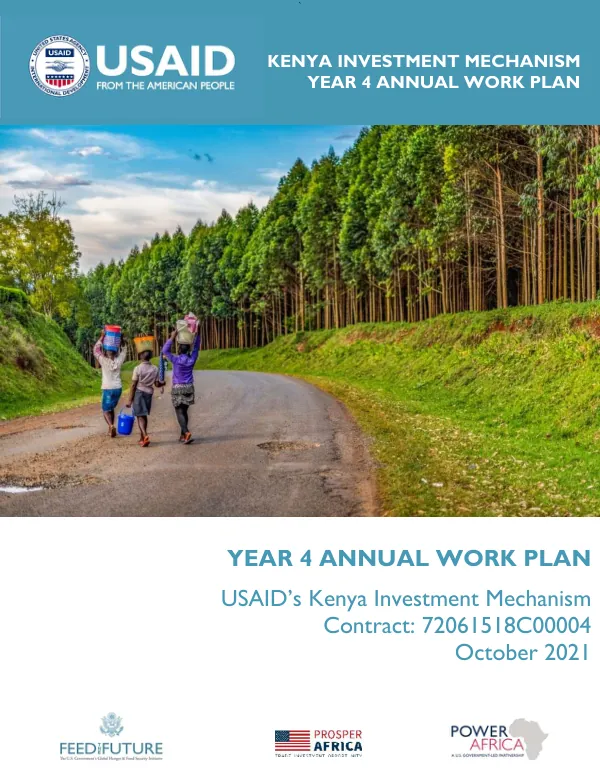
Year 4 Annual Work Plan: USAID’s Kenya Investment Mechanism
The Kenya Investment Mechanism (KIM) is a five-year activity designed to unlock $520 million of investments for targeted areas of agriculture, energy, infrastructure, health, water, sanitation, and hygiene (WASH).
2021 · 61 pages
Sign in to readA free account is required to download.
Abstract
The KIM activity was awarded for implementation from August 15, 2018, through August 14, 2023. The Year 4 Annual Work Plan (AWP) submission for the KIM activity covers the period of October 1, 2021, to September 30, 2022. KIM's goals and objectives are centered around mobilizing capital, facilitating an enabling environment conducive to investments, and providing Development Finance Corporation (DFC) guarantee management and risk mitigation for financial institutions (FIs). The KIM activity has a broader geographic scope, covering the East African Community (EAC) plus Ethiopia, and has integrated USAID's Journey to Self-Reliance (J2SR) policy into the program design. The KIM team has adjusted its operating model to accommodate COVID-19 physical distancing requirements, using a hybrid office work model with majority working from home through tools like Microsoft Teams, Zoom, and Google meet. All training courses, networking events, and meetings with stakeholders have been re-tooled and moved to online platforms. KIM's technical response strategy involves adjusting and scaling smart incentives to business advisory service providers (BASPs) and FIs to respond to current market conditions and reduce start-up costs to enter or deepen engagement in agriculture and other key sectors for Kenya and East Africa's development. The strategy also includes replicating and scaling creative approaches to unlock financing by establishing a diverse range of sustainable strategic partnerships for inclusive growth. The KIM activity has identified several key objectives, including mobilizing capital, facilitating an enabling environment, and providing DFC guarantee management and risk mitigation for FIs. The activity has also prioritized resources to respond to the market's most pressing needs, particularly considering the economic crisis resulting from the COVID-19 pandemic. KIM's partners and stakeholders have informed the preparation of this AWP, and the activity has used a collaborating, learning, and adapting (CLA) approach to prioritize alignment in strategic objectives and next steps for co-created and co-financed activities with partners. The KIM activity has also considered the COVID-19 pandemic and the (re)emergence of a conservative banking culture that is hesitant to support KIM's targeted value chains, by learning from and adapting to these changes with strategic improvements in the design of this work plan. The KIM activity has identified several key activities, including identifying strategic partnerships, scaling impact of existing partnerships, and facilitating an enabling environment conducive to investments. The activity has also prioritized resources to respond to the market's most pressing needs, particularly considering the economic crisis resulting from the COVID-19 pandemic. KIM's work plan is a product of input provided via forums, networking events, partnership and stakeholder feedback, joint work planning sessions, program reviews, and pause-and-reflect sessions that evaluate program successes and challenges. The KIM activity has used a CLA approach to prioritize alignment in strategic objectives and next steps for co-created and co-financed activities with partners. The KIM activity has also identified several key cross-cutting priority areas, including women's economic empowerment, youth employment, and environmental sustainability. The activity has prioritized resources to respond to the market's most pressing needs, particularly considering the economic crisis resulting from the COVID-19 pandemic. Overall, the KIM activity is designed to unlock $520 million of investments for targeted areas of agriculture, energy, infrastructure, health, water, sanitation, and hygiene (WASH), and has a broader geographic scope covering the East African Community (EAC) plus Ethiopia. The activity has integrated USAID's Journey to Self-Reliance (J2SR) policy into the program design and has used a CLA approach to prioritize alignment in strategic objectives and next steps for co-created and co-financed activities with partners.
Related documents