USAID DEC
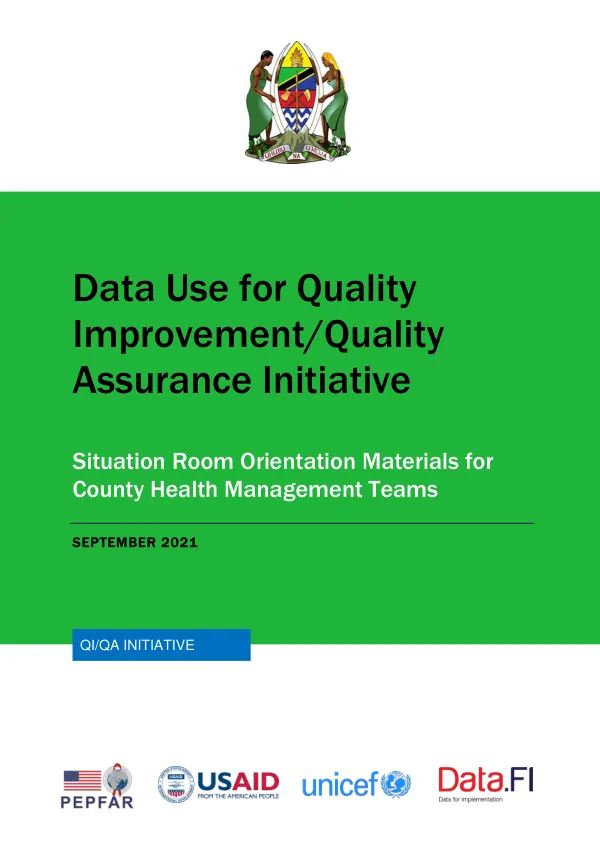
Data Use for Quality Improvement/Quality Assurance Initiative: Situation Room Orientation Materials for County Health Management Teams
Sign inPALLADIUM INTERNATIONAL, LLC
Data Use for Quality Improvement/Quality Assurance Initiative: Situation Room Orientation Materials for County Health Management Teams
The Quality Improvement/Quality Assurance Initiative in Tanzania aims to enhance the use of data for quality improvement in the country's health sector.
2021 · 84 pages
Sign in to readA free account is required to download.
Abstract
The initiative was launched in May 2021, following a request from the Government of Tanzania's President's Office Regional Administration and Local Governance (PORALG) to modify and scale up a quality assurance/quality improvement process. The initiative involves the development of a technical advisory group (TAG), composed of experts from PORALG, the Ministry of Health, Community Development, Gender, Elderly and Children (MOHCDGEC), USAID, and UNICEF. The TAG formally launched in May 2021, along with seven sub-technical groups that will support a TAG Joint Implementation Plan. The Joint Implementation Plan captures a range of activities that will support data use for the quality improvement (QI) initiative, with implementation shared among PORALG, Data.FI, and UNICEF in support of PORALG's vision. As part of this joint initiative, Data.FI will build the capacity of selected council health management teams (CHMTs) to use data for QI/QA improvement. Draft orientation materials for CHMTs were first developed in June/July 2021 and validated by national stakeholders during a TAG sub-committee meeting on July 27 and 28. The orientation materials were then piloted at Chamwino District Council from August 2-4, modified, and used for CHMT orientations in three additional councils. The Situation Room Orientation Materials for County Health Management Teams include an overview of the initiative, background information, and a design workshop agenda. The design workshop agenda describes the various sessions included in the workshop, which aims to orient CHMT members to conduct their own quality improvement projects within the context of Situation Room meetings. The workshop covers topics such as understanding quality improvement tools, constructing Driver Diagrams, ensuring stakeholder engagement, and facilitating participatory meetings. The workshop is divided into three days, with each day focusing on specific objectives. Day One is dedicated to providing background and justification for the Situation Room intervention, while Day Two delves into the development of the Driver Diagram. Day Three concludes with the Action Plan for implementation in the Council. The agenda guides the design process and can be extended to four days, depending on the learning needs of different audiences. The primary objective of the workshop is to orient CHMT members to conduct their own quality improvement projects within the context of Situation Room meetings. The learning objectives include understanding quality improvement tools, constructing Driver Diagrams, ensuring stakeholder engagement, and facilitating participatory meetings. The workshop includes presentations, group work, and simulations to facilitate learning and engagement among participants. The initiative aims to enhance the use of data for quality improvement in the country's health sector, with a focus on improving staff productivity and the quality of health services. The Situation Room Orientation Materials for County Health Management Teams provide a comprehensive overview of the initiative and the design workshop agenda, which aims to build the capacity of CHMTs to use data for QI/QA improvement.