USAID DEC
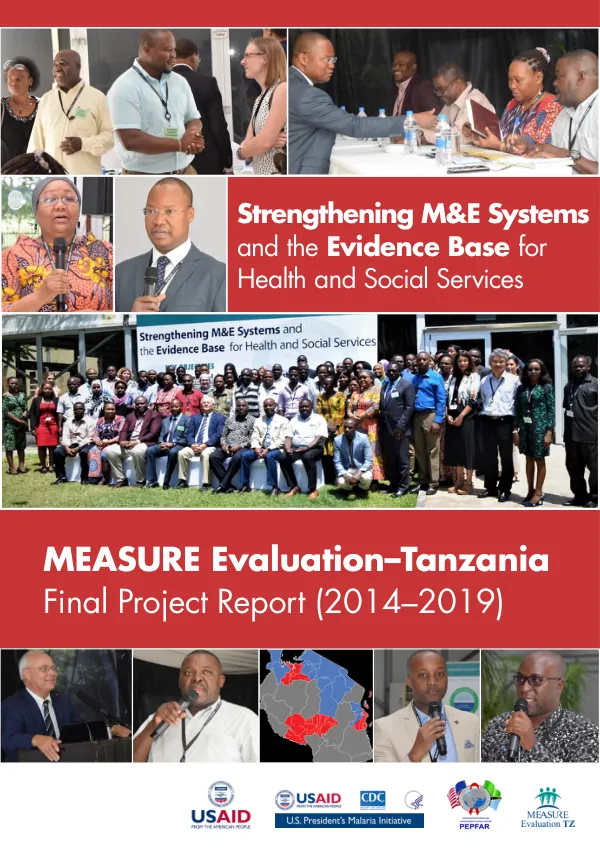
Final Project Report (2014–2019): Strengthening M&E Systems and the Evidence Base for Health and Social Services
Sign inICF
Final Project Report (2014–2019): Strengthening M&E Systems and the Evidence Base for Health and Social Services
The MEASURE Evaluation–Tanzania project was a five-year initiative aimed at strengthening monitoring and evaluation (M&E) systems and the evidence base for health and social services in Tanzania.
2019 · 73 pages
Sign in to readA free account is required to download.
Abstract
The project was implemented from 2014 to 2019 and received funding from the President's Emergency Plan for AIDS Relief (PEPFAR) through the United States Agency for International Development (USAID). The project's technical approach focused on three key areas: National HIV and Most Vulnerable Children (MVC/OVC) M&E System Strengthening, Health Management Information Systems (HMIS), Data Quality and Data Use, and Malaria: Surveillance and Operations Research. The project also included HIV Research and M&E Capacity Building. Key achievements in the National HIV and MVC/OVC M&E System Strengthening cluster included the development of a national M&E framework, the establishment of a national data quality improvement plan, and the implementation of a data management system. The project also supported the development of a national HIV surveillance system and the implementation of a data quality improvement plan. In the HMIS, Data Quality and Data Use cluster, the project supported the development of a national HMIS, the implementation of a data quality improvement plan, and the establishment of a data use plan. The project also supported the development of a national data quality improvement plan and the implementation of a data management system. The Malaria: Surveillance and Operations Research cluster focused on strengthening malaria surveillance and operations research in Tanzania. Key achievements included the development of a national malaria surveillance system, the implementation of a data quality improvement plan, and the conduct of operations research studies to inform malaria control programs. The HIV Research and M&E Capacity Building cluster focused on building the capacity of Tanzanian researchers and M&E professionals to conduct high-quality research and evaluations. Key achievements included the development of a national research agenda, the conduct of research studies, and the provision of training and technical assistance to Tanzanian researchers and M&E professionals. The project also made significant progress in terms of sustainability, with a focus on building the capacity of Tanzanian institutions and stakeholders to continue the work of the project after its completion. The project's performance monitoring plan included a range of indicators to track progress and measure success. Lessons learned from the project included the importance of building strong partnerships with Tanzanian institutions and stakeholders, the need for a robust technical approach, and the importance of prioritizing data quality and use. The project also identified challenges, including limited resources and capacity constraints, and made recommendations for future projects, including the need for continued investment in M&E capacity building and the importance of prioritizing data quality and use. The project's findings and recommendations are presented in the report, along with detailed results of the Orphans and Vulnerable Children (OVC)/Most Vulnerable Children (MVC) Monitoring, Evaluation, and Reporting (MER) study and a synopsis of small grant-funded studies.
Related documents