RESEARCH TRIANGLE INSTITUTE (RTI)
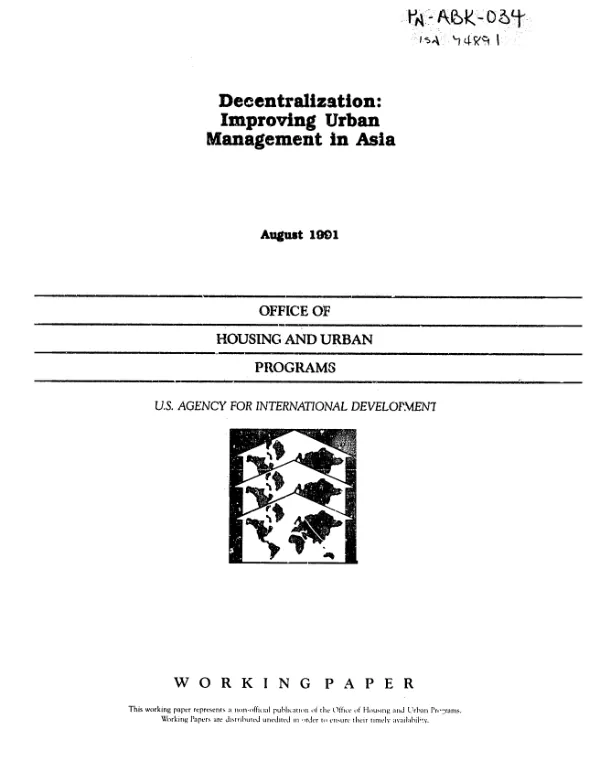
Decentralization : improving urban management in Asia
In Asia and throughout the developing world, existing institutional arrangements for urban management are inadequate to the task.
Johnson, Ronald W. · 1991
Sign in to readA free account is required to download.
Abstract
Capabilities in managing land and infrastructure are especially weak. At the same time, however, most Asian countries are experiencing a rapid increase in urban population, as well as an increased economic dependence on urban areas. Using data primarily from Asia, this paper analyzes the potential for improving urban management by decentralizing authority for planning, financing, and implementing a number of urban functions. While the paper concerns both national and subnational institutions, its focus is on local governmental institutions and their role in managing the urban system, either through direct planning, financing, and production of urban services, or through regulatory and cooperative operations with the private sector. The major finding is that a decentralized institutional framework potentially can improve management of urban systems, if accompanied by actions that enable local institutions to increase their leverage over specific urban management functions. The paper also identifies some constraints to decentralization strategies. A final section presents an action agenda identifying key issues that central and local institutions should consider in developing and implementing a decentralization strategy.
Related documents