USAID DEC
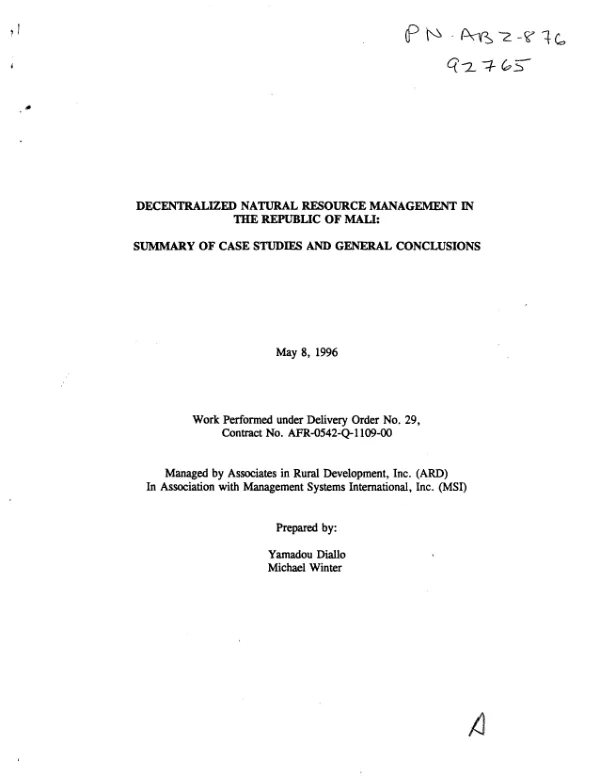
Decentralized natural resource management in the Republic of Mali : summary of case studies and general conclusions
Sign inASSOCIATES IN RURAL DEVELOPMENT, INC. (ARD)
Decentralized natural resource management in the Republic of Mali : summary of case studies and general conclusions
This report, written for member States of the Permanent Interstate Committee for Drought Control in the Sahel (CILSS), summarizes four case studies of decentralized natural resource management (DNRM) in contemporary Mali.
Diallo, Yamadou; Winter, Michael · 1996
Sign in to readA free account is required to download.
Abstract
The case studies examine: (1) the capacities and limits of village-level management in regard to Ibissa"s natural spring; (2) village management of forestry resources and supra-village management of conflict in the Kelka forest; (3) the financial aspects of DNRM involved in improving and managing Nagnassoni"s waterhole; and (4) efforts in Kita to increase the value of forest resources, particularly firewood, as an incentive to improving the extent to which local groups manage forests in a sustainable fashion. For each of the four case studies, the report provides background information, a brief narrative description of local-level management practices, and a critical appraisal of their strengths and weaknesses. The second part of the report provides a brief overview of the decentralization process in Mali, looked at from both "above" and "below". Within that overall context, the report uses the four case studies to identify the principal constraints to DNRM in Mali. Generally speaking, while local populations possess the capacity and many of the skills necessary for DNRM, they are subject to a number of economic, financial, institutional, technical, and social constraints. A final section of the report contains recommendations to facilitate effective DNRM. (Author abstract, modified)
![Lessons from school-based environmental education programs in three African countries [Mali, Tanzania, and Zambia]](https://covers.devme.ai/gen/17138.webp)