ACADEMY FOR EDUCATIONAL DEVELOPMENT, INC. (AED)
Decentralizing education : the BESO/Tigray case study -- a summary
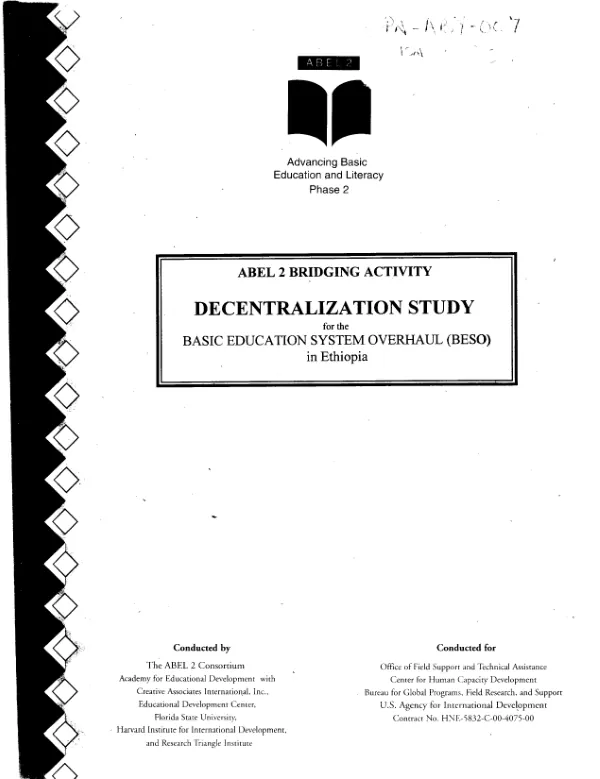
The Tigray Decentralization Study was carried out in Tigray Region, in northern Ethiopia, from July to October 1995, as one of the bridging activities leading to the start-up of USAID"s Basic Education System Overhaul (BESO) Project.
1996
Sign in to readA free account is required to download.
Abstract
The study"s primary objective was to model a new, decentralized process for addressing the problems of Tigray"s education system -- a system being rebuilt after two decades of war. The study was carried out in a context in which the central government had promulgated, but not yet defined, a policy of decentralization to the regional level. The study methodology included a series of five participatory workshops -- involving educators from all levels of Tigray"s education system -- at which data collected by the research team at school and system levels were presented. This process brought to the surface two different interpretations of decentralization in Tigray -- one focused at the regional level and the other more concerned with schools, local administrative offices, and communities. From the first perspective, the primary task was for the regional office to obtain the resources and capacities to manage the system. From the second, decentralization had done little to improve the schools, or their relationships with the education administrative system. The primary task was to develop new relationships between school and the administrative organization. These perspectives framed very different approaches to system reform. Though the study did not bring about fundamental changes in the system"s decision making, it did model a decentralized process for incorporating field data and participatory dialogue into the policy formation process. It provided comparative data about the Region"s schools and gave front-line educators an opportunity to discuss the system"s organization and its future. (Author abstract, modified)
![Overlooked and undervalued : a synthesis of ERNWACA [Educational Research Network for West and Central Africa] reviews on the state of educational research in West and Central Africa](https://covers.devme.ai/gen/65178.webp)